With more models to choose from, falling running costs, and greater acceptance among drivers, Tasmania may have reached an EV tipping point. That’s good news for the climate and for household budgets. But sustaining the EV revolution will require better charging infrastructure and changes to how we pay for our roads.
A quick guide to electric vehicles
There's a bewildering range of EVs and hybrid vehicles on the market, but we're focusing on fully electric cars.
- Fully electric vehicles, technically known as battery electric vehicles (BEVs), run entirely on electricity stored in a rechargeable battery. These are the focus of our analysis, and we’ll refer to them simply as ‘EVs’ throughout this article.
- Hybrid electric vehicles (HEVs) combine a petrol or diesel engine with an electric motor. Some can be plugged in to charge, and others recharge their batteries as they drive. We’ve excluded HEVs from our analysis because they still rely on fossil fuels.
- Conventional petrol and diesel vehicles, also known as internal combustion engine vehicles (ICEVs). We compare these with fully electric cars throughout the article.
Tasmania's 2026 EV boom
The number of EVs on Tasmanian roads has surged dramatically in recent years. In November 2021, there were only
808 registered EVs in Tasmania. By September 2026, that number had skyrocketed to
9,022 registered EVs, with more than a quarter of those vehicles (2,497) registered between March and September 2026.

Despite this rapid growth, EVs still make up just 0.84% of all cars on Tasmanian roads, compared with the
national average of 1.16%.
Plug-in hybrid vehicles (PHEVs) are also becoming more popular across Australia. They accounted for approximately 9% of new vehicle sales in the first half of 2026, up from 4.2% in 2025. But
fully electric vehicles are growing even faster, accounting for 17.7% of sales between January and July 2026, up from 7.7% in 2025.
Behind the surge in EV sales
Perhaps unsurprisingly, rising petrol and diesel prices have made EVs a lot more attractive to Australians. In 2025, the average price of petrol was
$1.79 per litre across Australia. But the conflict in the Middle East has pushed prices as high as
$2.57 per litre in some parts of the country (including here in Tasmania) over the past few months.
High fuel prices aren’t the only reason EV sales are taking off. The Federal Government’s
Electric Car Discount has also helped more than
100,000 Australians buy an EV since 2022 by removing fringe benefits tax on eligible vehicles. But with EVs becoming cheaper to own and run, it’s not clear whether this
$2 billion-per-year subsidy is still needed.
Australians also have more electric cars to choose from, and drivers are becoming more familiar with the technology. There are now
196 EV models on the market, up from 153 models a year ago. The introduction of the
New Vehicle Emissions Standard (NVES) has also helped expand the range of options available.
Research from Melbourne and Sydney shows that wealthier suburbs tend to have higher rates of EV ownership, although the same is true of new car purchases more generally. Organisations such as the Grattan Institute have called for more targeted support to help lower-income households access EVs, including
subsides for lower-priced models and
exemptions from taxes such as stamp duty.
And while most Australians buy second-hand cars, the used EV market is also starting to grow. Sales of second-hand fully electric vehicles (meaning BEVs)
increased by 54.6% in the first half of 2026 than in 2025. More used EVs are also expected to become available as existing vehicle leases start to expire.
The cost of owning an EV
Our analysis suggests for EVs to become a mainstream choice for Australian motorists, three conditions must be met:
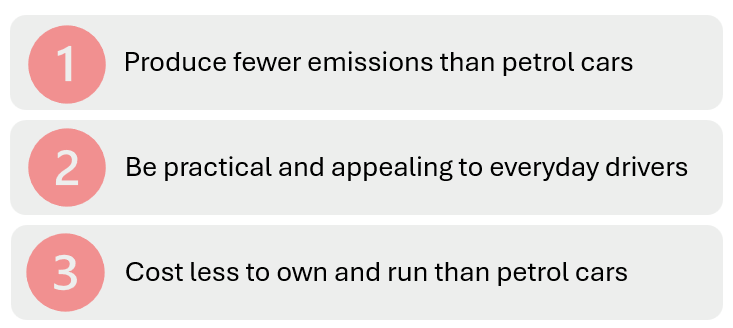
We already know that EVs produce substantially fewer emissions than petrol cars. And with more models to choose from and growing acceptance among drivers, they’re becoming a practical option for more people. That leaves the third and all-important consideration: whether EVs are now cheaper to own and operate than comparable petrol cars.
To find out, we’ve developed a model that compares the total cost of owning an electric car with a similar petrol car in Tasmania. Rather than looking at the purchase price alone, our model includes registration, insurance, fuel or electricity, tyres, servicing, maintenance, and depreciation (i.e., how much a car loses in value over time).
Our Total Cost of Ownership (TCO) model incorporates the following assumptions:

Source: Some of these icons were created by artists from the
Noun Project.
To compare the cost of owning an EV with a similar petrol car, we selected five pairs of vehicles, ranging from small hatchbacks to large SUVs. We then calculated how much each would cost to own and run over five years, using 2026 prices and including petrol at $2.50 per litre. This allows us to compare the true cost of buying, owning, and running a wide range of vehicles under typical Tasmanian conditions.
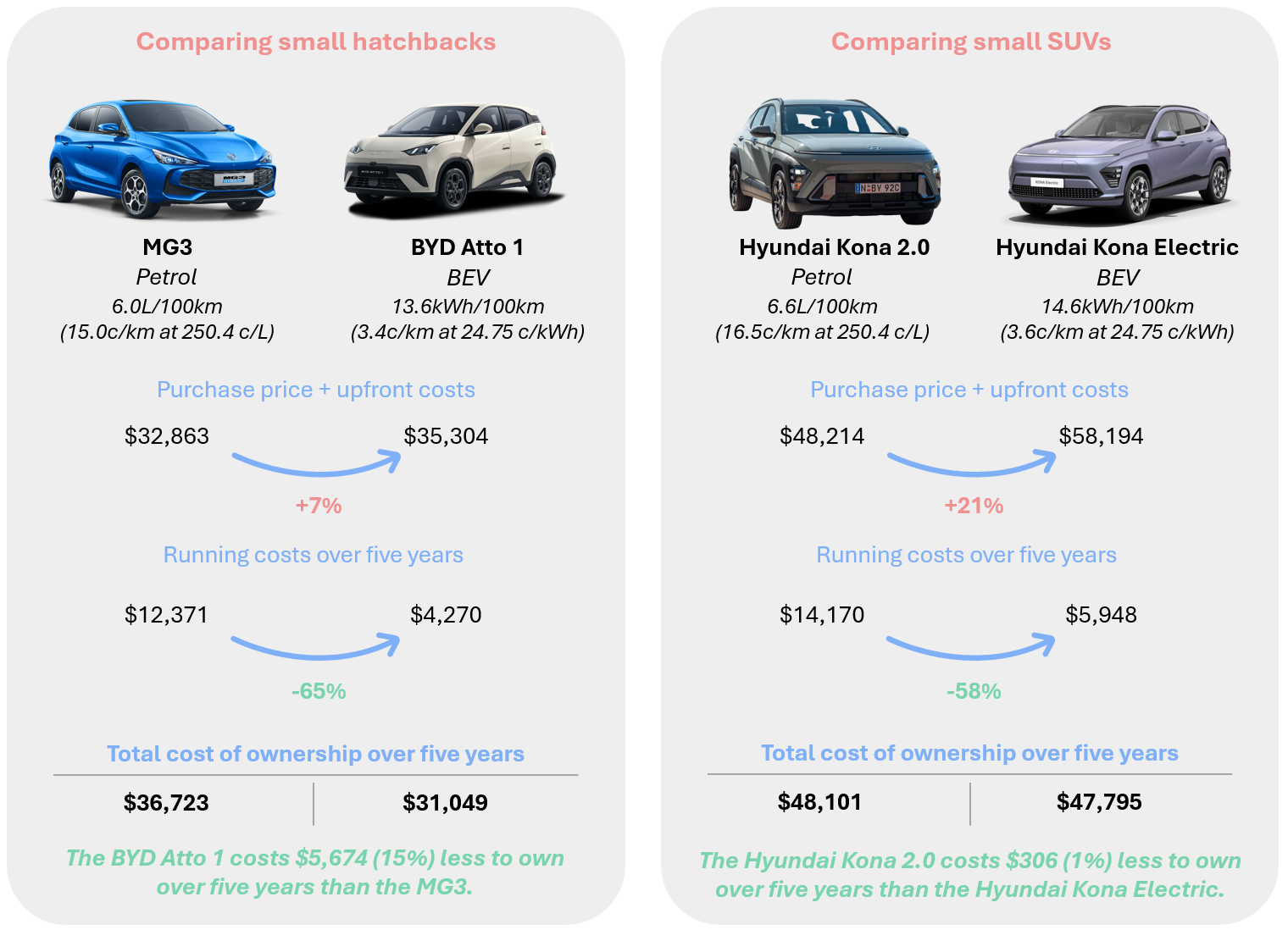
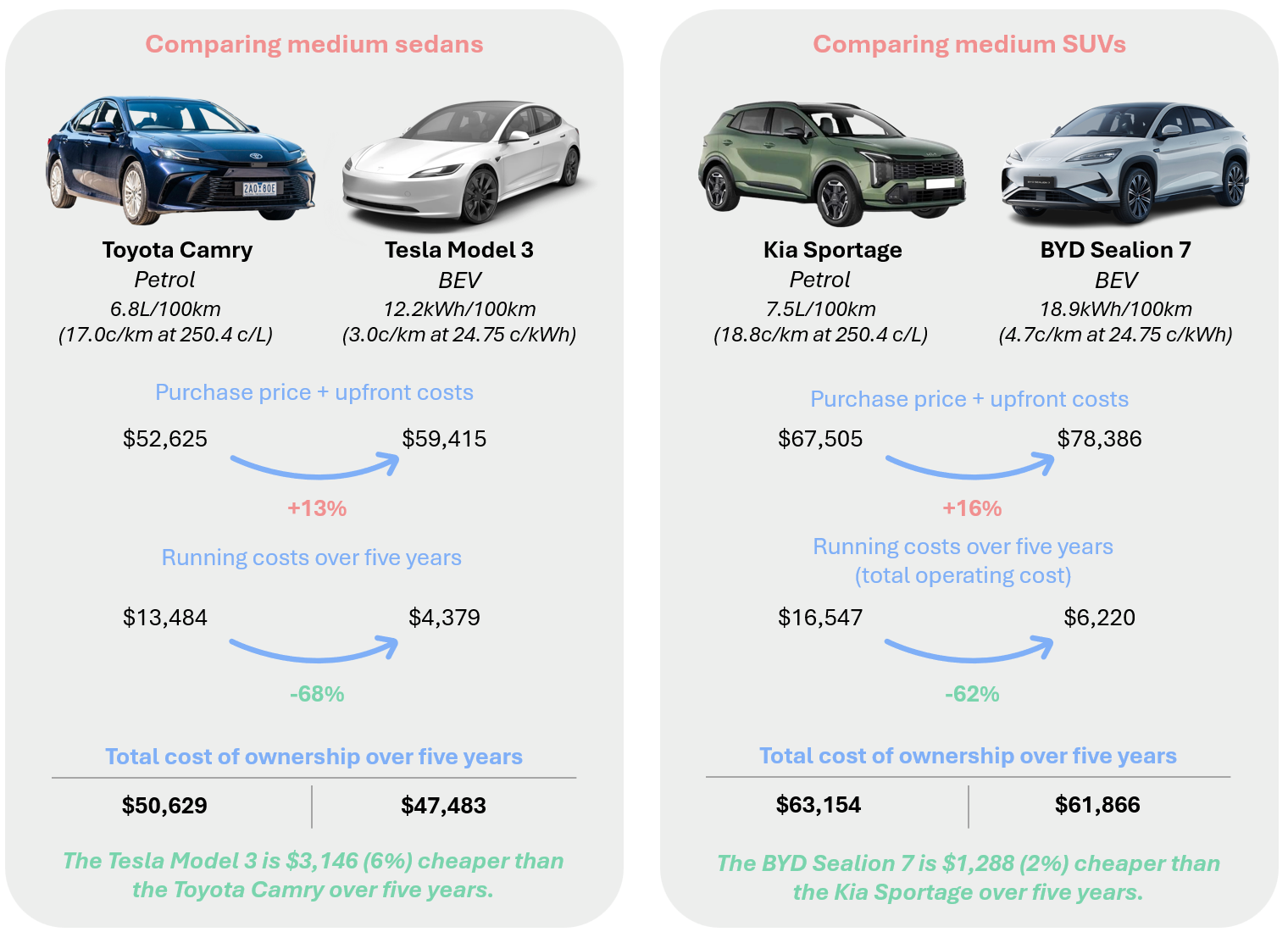
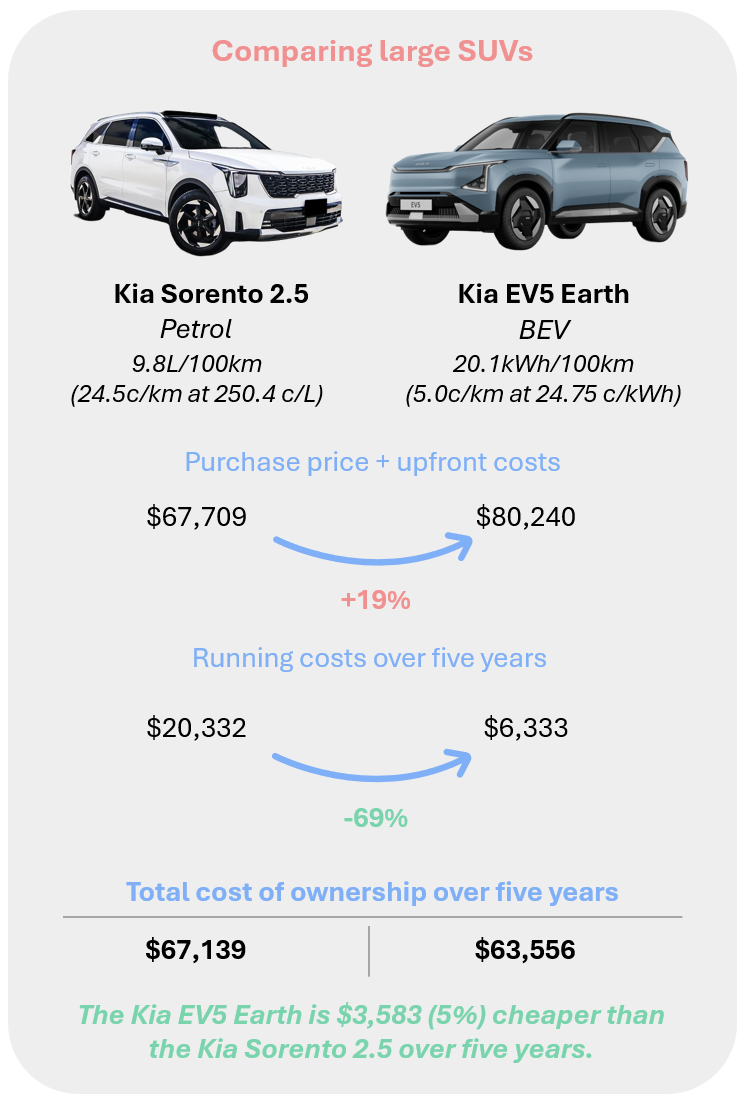
Image sources: MG3,
Hyundai Kona 2.0,
Kona Electric,
Atto 1,
Toyota Camry,
Tesla Model 3,
Kia Sportage,
Sealion 7,
Kia Sorento. The curved arrow icon was created by 4B Icons from the Noun Project.
Our modelling shows that EVs, when charged at home on an off-peak electricity rate, are cheaper to own over five years across all five vehicle categories. The savings range from 1% to 15% compared with similar petrol cars. Although new ICEVs cost 7 to 21% less to buy upfront, they’re more expensive to run when petrol costs $2.50 per litre. Over five years, the lower running costs of EVs make up for their higher purchase prices.
Importantly, these comparisons are based on buying a car outright, rather than through a subsidised lease. This means EVs are already as affordable, or nearly as affordable, as comparable petrol cars without relying on the Commonwealth Fringe Benefits (FBT) exemption for leased vehicles. On the other hand, when road user charges are introduced in Australia, EV owners will also need to contribute to road funding to help make up for the decline in fuel excise revenue as more motorists switch to EVs.
What if petrol gets cheaper?
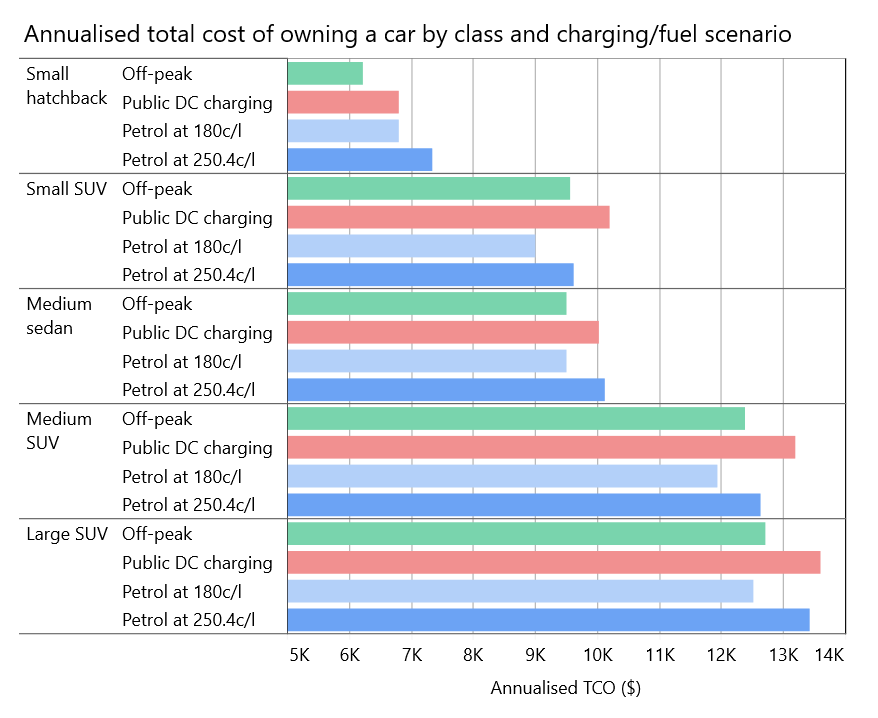
Of course, it’s very possible that petrol prices may not stay at $2.50 per litre. To understand how falling fuel prices could affect the cost of owning an EV, we also compared the vehicles using the 2025 average price of $1.80 per litre.
Data source: Estimates derived from TPE’s total cost of ownership model,
using input data compiled from multiple relevant sources in Tasmania.
At $1.80 per litre, the cost advantage of EVs shrinks considerably. When petrol costs $2.50 per litre, EVs are cheaper to own over five years across all five vehicle categories. But at $1.80 per litre, only two categories remain cheaper (by up to 6%), while the other three cost 4 to 6% more.
Even with cheaper fuel, EVs still cost 40 to 53% less to run. However, those savings are no longer enough to fully offset their higher purchase prices. Of course, if petrol prices return to 2025 levels or thereabouts, EV manufacturers may also lower their prices to remain competitive. But for now, that’s speculation.
There are three key takeaways from our modelling:
1. Vehicle size matters
Generally, the smaller the EV, the greater the cost advantage over a comparable petrol car. This is largely because batteries are one of the biggest contributors to the higher upfront cost of EVs. However, larger EVs save more on fuel.
2. Charging at home makes a difference
Access to affordable home charging is key to getting the most savings from an EV, particularly on an off-peak electricity rate or using rooftop solar. Public fast charging costs almost three times as much as off-peak charging, reducing the overall savings. While EVs are still 36% to 48% cheaper to run than petrol cars even when using public chargers, households relying on them (particularly renters and apartment residents) benefit the least.
3. Fuel prices will continue to influence EV sales
High petrol prices are making EVs more attractive to buyers. If petrol prices return to 2025 levels, EV sales may slow.
The cost to the environment
The Australian Government is counting on EVs to do a lot of the heavy lifting in cutting transport emissions. Under its
Transport and Infrastructure Net Zero Roadmap and Action Plan, Australia aims to reduce emissions from private transport by 90% by 2050, from 42 million tonnes in 2025 to just 4 million tonnes.
To estimate how much EVs could reduce Tasmania’s transport emissions over the next decade, we’ve used projections from
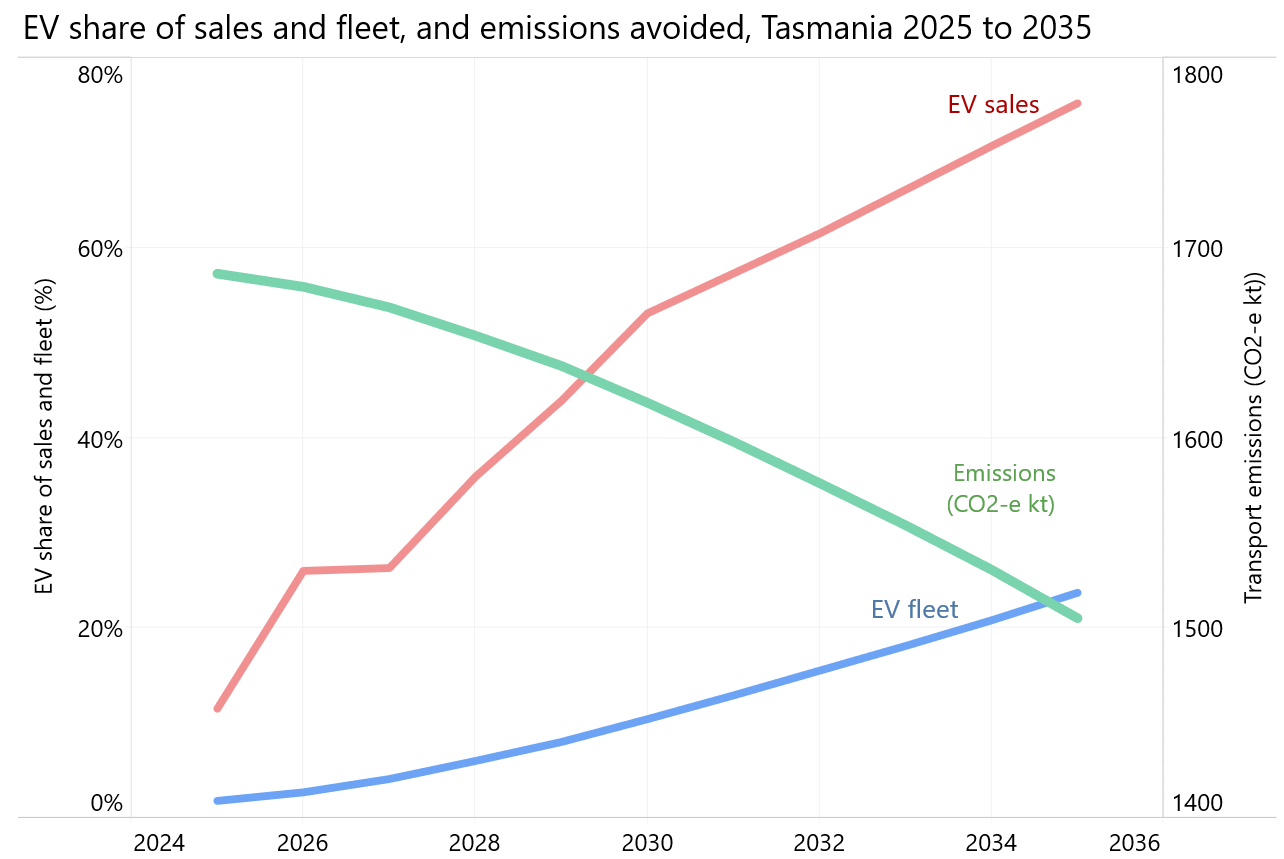
CSIRO’s “Step Change” scenario, which models a middle-of-the-road pathway for the shift to cleaner energy. Our modelling suggests that by 2035, three in every four new cars sold in Tasmania will be electric. But because cars last a long time, only one in four cars on our roads will be electric by then – up from around two in every hundred today.
Even so, that shift could cut Tasmania’s transport emissions by around 11% (or approximately 200,000 tonnes of greenhouse gases) by 2035.
The road ahead for EVs
Because we’re seeing many of the barriers to EV ownership falling at the same time, Tasmania may be reaching a classic
technology adoption tipping point. Electric cars are moving from a niche product to a mainstream choice for households. And as we’ve seen throughout 2026, rising petrol prices have made the environmental and fuel-security benefits of EVs an added bonus, rather than a trade-off.
As more EVs hit the road, their popularity is likely to keep growing. More people will become familiar with the technology, the second-hand market will expand, and investment in charging infrastructure will increase, making EV ownership even more appealing.
Historically, EV ownership has been largely concentrated among wealthier households that could afford the higher upfront costs. But a growing second-hand market could make electric cars accessible to many more Tasmanians. As more leased EVs enter the used car market over the next few years, prices should become more affordable. The fact that new EVs are now as cheap, or nearly as cheap, to own over five years when compared to petrol cars is an important milestone. But we have yet to see what will happen if the price of petrol comes down.
The challenge is now for policy to keep pace with growing EV ownership. That means we will need more public and private investment to improve charging infrastructure and introducing road user charges, while ensuring the benefits of the transition are shared fairly across communities.
The cover image for this article is available on Unsplash.