home-insurance costs in Tasmania and examine how climate risk is
reshaping the insurance market. We also propose policy options that could help keep insurance accessible and affordable while strengthening Tasmania's resilience. The analysis below is drawn from a
detailed report on insurance affordability by the Tasmanian Policy Exchange, done in partnership with RACT.
Why insurance is becoming more expensive
Over the past 10 years, the cost of general-insurance products in Australia has increased by
76 percent on average – more than twice the rate of inflation. Premiums in Tasmania have risen more slowly than elsewhere, but they are still putting significant financial pressure on families and businesses. Households in areas at high risk of floods and bushfires are facing particularly steep increases.
Although most Tasmanian households pay lower home-insurance premiums than the national average, there are big differences across the state and coverage in high-risk areas can be extremely expensive. Our analysis found that more than 20,000 Tasmanian households are already paying over $1,000 for fire and flood cover alone – and in some cases much more.
By 2040, the number of households paying the equivalent amount in real terms is expected to more than double to around 41,000 properties, mostly due to growing climate risk. And that’s just for coverage against fire and flood damage. All the other components of a standard home insurance bill would probably add at least another $2,000 to most of these policies.
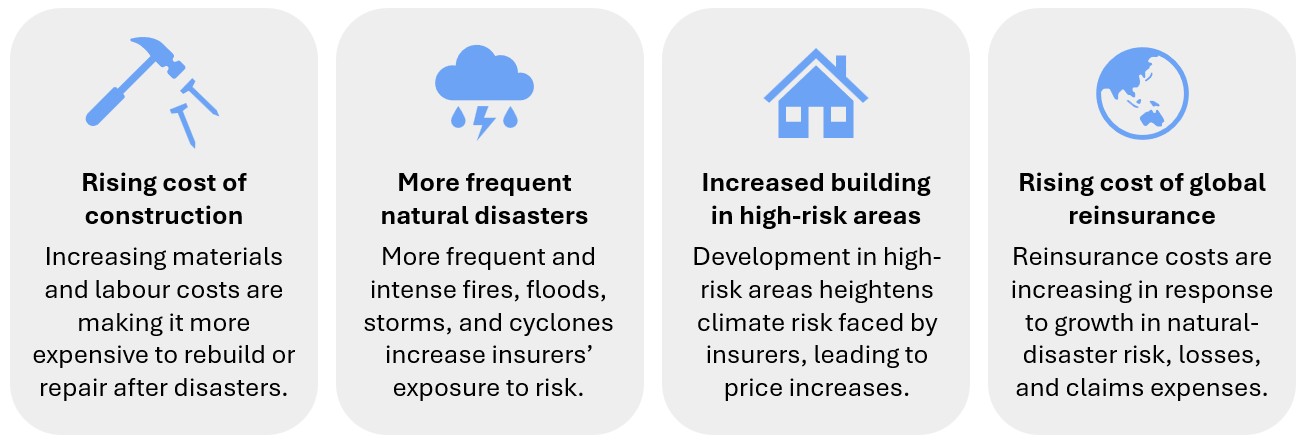
There are several factors pushing insurance prices higher and (spoiler alert) many of them are related to the impacts of climate change:
It’s not just consumers feeling the pinch of rising costs. Insurers themselves are under growing pressure to cover their claims expenses in a tight and competitive market. Despite significant growth in premium prices, rising claims costs and a series of major natural disasters have meant Australian insurers recorded net losses on home-insurance policies in four of the past five years for which data are available.
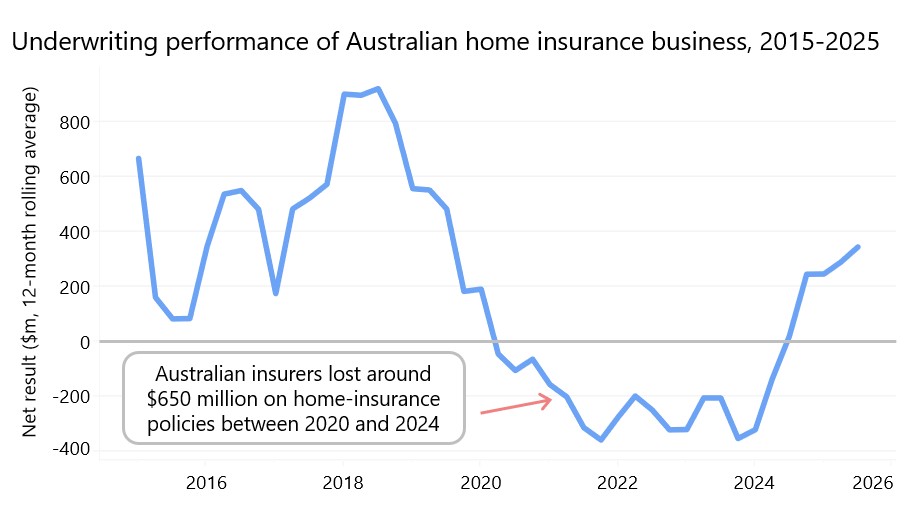
Source:
APRA Quarterly General Insurance Statistics Note: Underwriting performance measures whether insurers make profit or loss from selling insurance policies. It is measured by comparing the revenue from insurance premiums with the losses from claims and operational cost.
Some of the more immediate pressures insurers face, such as the spike in construction costs during the COVID-19 pandemic, have started to ease. But the big, long-term issue driving price rises (climate change) is here to stay.
The
Insurance Climate Vulnerability Assessment warns that climate change is dramatically increasing the number of properties in very high-risk zones. It estimates that up to 2.4 million Australian homes could become effectively uninsurable by 2050 under some warming scenarios. According to the
Australian Prudential Regulation Authority (APRA) “this is equivalent to around 40,000 additional households (on average) losing insurance protection every year for the next 25 years”.
Unless we can find innovative ways to reduce climate risk, build community resilience, and support adaptation, insurance will keep getting more expensive and coverage rates will continue to fall.
How home insurance premiums are calculated
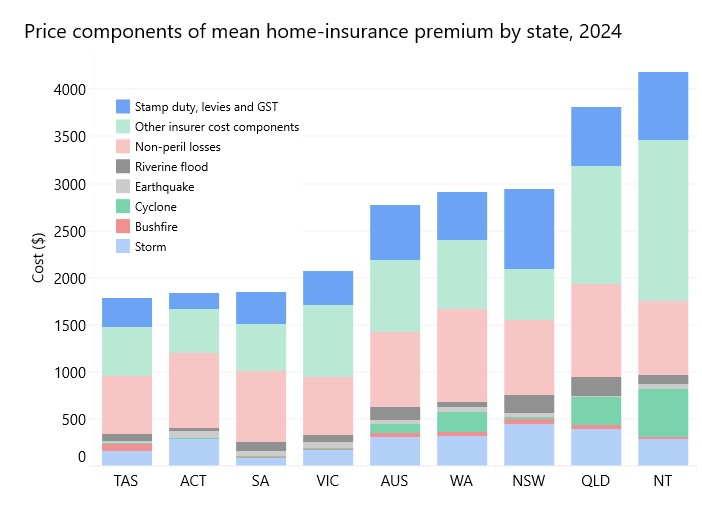
Insurance markets are highly complex. So, before looking at how we can better manage the impacts of climate change on insurance pricing, it helps to understand how insurance premiums are calculated. The final price of most ‘general insurance’ products (a category that includes home and contents, motor, commercial, and professional-liability insurance products) contains several different components.
To calculate an insurance premium, insurers use
sophisticated risk models to estimate the likelihood and potential impact of a wide range of hazards, from theft and accidental damage to cyclones and bushfires. Once these risks have been priced, insurers typically protect themselves from particularly large loss events by taking out
reinsurance (which is basically insurance for insurance providers). Losses above certain agreed thresholds are then borne by the reinsurer in exchange for a share of premium revenue. Next, the insurers add their claims-handling expenses and profit margin before finally calculating GST and stamp duty.
The challenge is that two key steps of this process burden poorer households more than wealthy ones. First, evidence from Australia and around the world has
demonstrated that poorer households generally face higher climate risk on average than wealthier ones. Because higher risk equals higher premiums, poorer households pay more per dollar of insured value on average for coverage than their wealthier peers.
Second, the way insurance is taxed makes things even worse. Insurance taxes are calculated as a percentage of the premium price, regardless of the insured value of the property that the policy covers. This means that two identical houses insured for the same amount will attract a different tax bill depending on where they happen to be located. Because climate risk is not evenly distributed, less well-off households often also pay more tax per dollar of insured value than wealthy ones, as the hypothetical example of the Smiths and the Joneses illustrates.
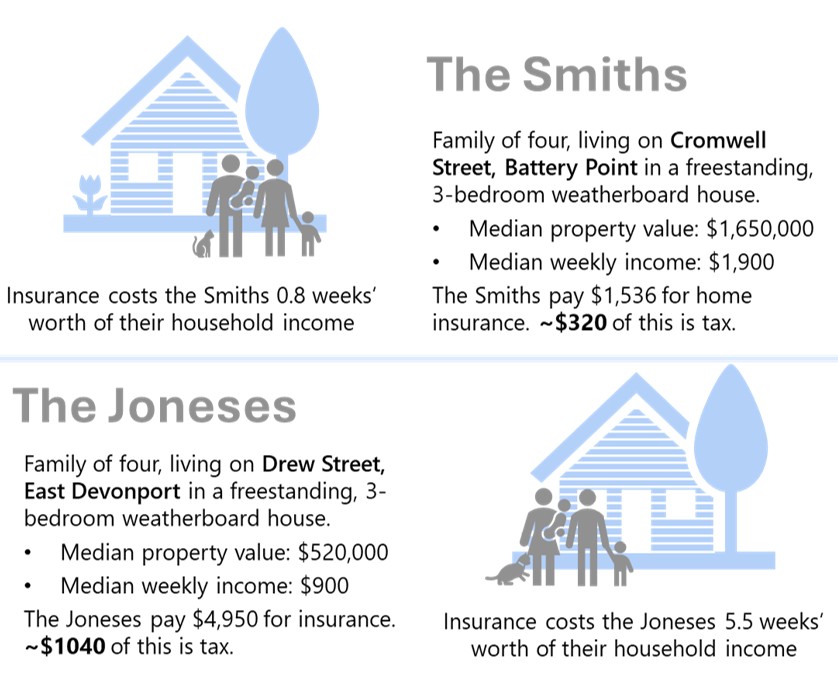
Source: median of quotes from several insurance comparison service websites
This is a problem because it means that the households with the greatest need for adequate insurance coverage face a bigger disincentive to buying it. It’s important that the price of insurance accurately reflects the risk of development in high-risk locations, but our tax system shouldn’t compound the burden this places on low-income households, particularly when moving somewhere safer might not be a viable option.
Sadly, as climate change worsens, the disparity in insurance affordability between rich and poor households will only widen. For example, our report finds that households facing the steepest increases in flood insurance cover over the next 15 years are overwhelmingly concentrated in very low-income areas. Some of the state’s poorest rural communities are also projected to see the cost of bushfire cover increase by around 70 percent in real terms by 2040.
Policy options to improve insurance affordability
Improving long-term insurance affordability means tackling the factors driving premiums higher. That includes reducing climate risk, lowering the cost of rebuilding after disasters, and reforming insurance taxes that disproportionately affect households facing the greatest risk.
There’s no single solution. But implementing a range of national, state, and local initiatives could help make insurance more affordable in Tasmania. This is the approach reflected in the Tasmanian Government’s recent memorandum of understanding with RACT, which is a positive and welcome development. We lay out some of the most promising options below.
1. Tackling the root cause of increasing peril risk
The single most important thing governments can do to reduce the cost of insurance is to address the biggest long-term driver of peril risk: climate change. Coordinated, evidence-based action to reduce emissions and encourage adaptation to climate risks is the surest way to limit further price increases. Tasmania can’t solve the global climate crisis on its own, but we can reduce our exposure to climate hazards by limiting further development in high-risk areas and investing in resilient infrastructure.
These actions create quantifiable benefits that enable insurers and reinsurers to lower premiums. The Launceston Flood Levee is a good example. Flood studies and modelling of the levee’s impacts have led insurers to cut their estimates of Tasmania’s annual flood risk by as much as 75 percent. In other words, the levee generates annual insurance premium savings of up to $14 million and prevented $216 million in losses during the 2016 floods. The levee itself cost just $58 million, meaning it has already paid for itself four times over after just one major flood event.
2. Reforming insurance taxes
The way we calculate insurance tax in Tasmania means that the highest-risk households, who also tend to be less well off, pay the most tax. This creates a clear disincentive for households in high-risk locations to maintain adequate coverage because the people who need insurance the most are the ones penalised for purchasing it. When disasters strike, this can leave governments footing the damage bill and providing costly ongoing support for uninsured and under-insured households, including emergency accommodation, social housing, and emergency financial assistance. This is why government is sometimes described as the ‘insurer of last resort’.
Many insurance industry bodies and the
Henry Tax Review have called for insurance taxes to be abolished. Given the financial pressures facing the Tasmanian Government, this is unlikely to happen here anytime soon. However, one simple change that wouldn’t cost government a cent would be to calculate the tax based on the sum insured rather than the premium value. Households insuring very expensive properties (mostly wealthy households) would pay a little more, while poorer households in high-risk areas would save. This would also have the positive impact of increasing coverage rates overall.
3. Building neighbourhood- and property-level resilience
Adaptation doesn’t just mean large scale projects such as building levees. There are also things that can be done at the neighbourhood level. For example, research from the
Fire Centre at UTAS suggests that more active management of bushland within 50m of homes could reduce the number of properties with a dangerous level of bushfire exposure in Hobart and Glenorchy by 68 percent – from 8,939 to 2,836.
At the individual property level, households can use online tools like the
Bushfire Resilience Rating Home Self-Assessment app to assess their property’s risk and get suggestions for improving bushfire resilience. Some lower-cost initiatives include adding mesh to stop embers entering gutters and clearing mulch, leaf litter, firewood, and other flammable materials within five meters of buildings. Educational programs such as
Sparking Conversations, Igniting Action have demonstrated that relatively simple risk-management actions like these can meaningfully reduce insurance premiums for participating households.
Keeping Tasmania insurable
At the end of the day, insurance is about managing risk. As Tasmania’s climate changes, a big source of risk is growing – and so is the cost of insuring against it. Without action, more households will face premiums that they struggle to afford, and more Tasmanians will be left financially exposed when disasters strike. This means that in the inevitable event of a major bushfire or other natural disaster,
the greatest impacts will fall on those who have the fewest resources to recover.
Keeping insurance affordable over the long term means tackling the factors that are making it more expensive in the first place. Insurance premiums need to reflect the risks that insurers are taking on. But there are some compelling ways of reducing those risks in the first place. Investing in climate adaptation, making homes and neighbourhoods more climate-resilient, and reforming the way insurance is taxed can all help limit insurance costs for Tasmanians. And ultimately, that will improve both community safety and our state’s economic security.
The
report this PIMBY was based on is a collaboration between the Tasmanian Policy Exchange and Royal Automotive Club of Tasmania (RACT) who provided financial support and invaluable insurance-industry insights. The views expressed herein are those of the author’s and not necessarily those of the University of Tasmania or RACT.
.png)





.png)