As we noted in
PIMBY #27, AI data centres also warrant particular attention because of their scale and enormous demand for energy. Much of the value they generate is dispersed or captured by owners and investors, with relatively little flowing directly to host communities.
Here in part two, we look first at how governments elsewhere are responding, before considering four areas where Tasmania can act to maximise public value: energy, employment and innovation, revenue raising, and broader community benefit-sharing.
What the rest of the country is doing
The effective regulation of AI generally, and AI data-centres in particular, has become a global priority.
International standards are being reviewed and numerous new agreements are being negotiated.
In Australia,
national policy will determine key aspects of data-centre investment, security, and energy-system implications. Governments across Australia are already developing guidelines, statements of expectations, and policy frameworks to facilitate data-centre investment and maximise the benefits for communities. But state-based policy and intergovernmental agreements will also be needed to protect and promote Tasmania’s distinctive needs and interests.
While approaches vary between jurisdictions, there’s broad agreement on the key issues that need to be addressed, many of which we explored in our Part 1 article. The main differences lie in how governments respond to them and the policy mechanisms they use.
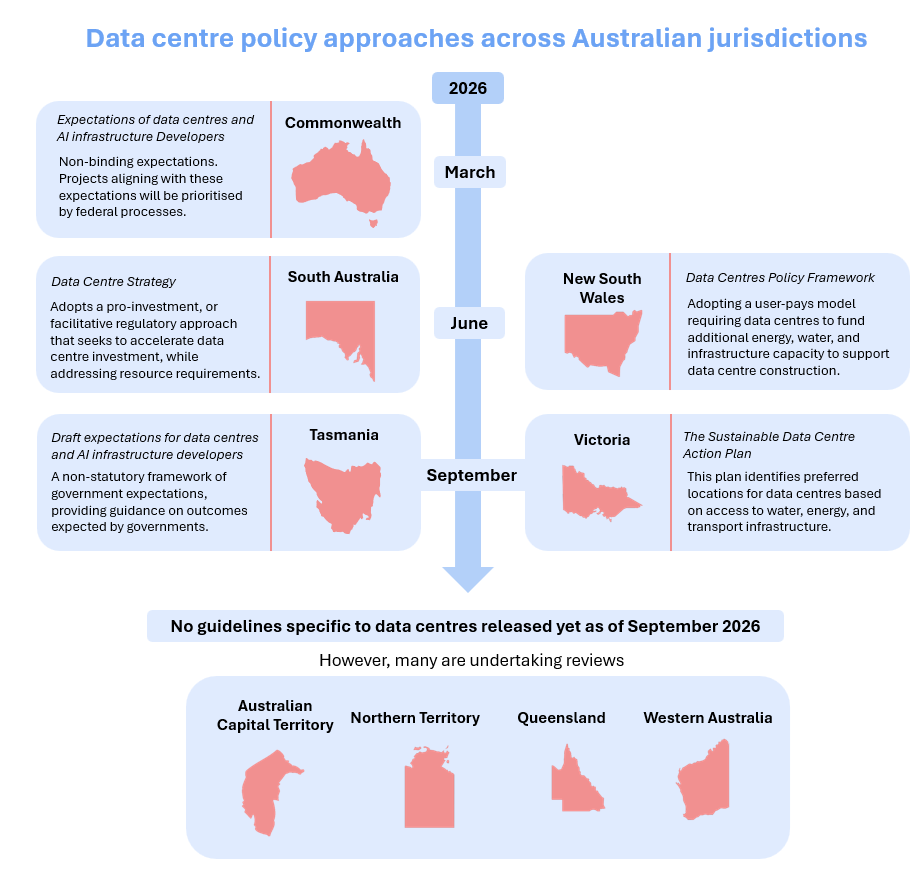
As the figure above shows, there is no single model for managing data-centre development. Instead, governments are using a mix of voluntary expectations, planning frameworks, investment incentives, and cost-recovery mechanisms.
Tasmania is also coming to grips with AI regulation. In 2025, it established one of the nation’s first ‘
AI Factory Zones’ in Northern Tasmania, intended to host what was then
Australia’s largest data centre, proposed by Firmus. While relatively new in Australia, these kinds of data-centre ‘
hubs’ or
clusters are common internationally, helping to concentrate development where it can access appropriate infrastructure. Alongside efforts to attract investment, Tassie has now begun considering the policy settings needed to manage it.
Developing Tasmania’s Draft Statement of Expectations for Data Centres
In August 2026, Parliament established an inquiry into the economic benefits, resource use, environmental effects, and community impacts of AI data centres. On 2 September, the Greens tabled
one of the largest parliamentary petitions in the state's history, with more than 10,000 Tasmanians calling for a moratorium on AI data-centre construction. On 7 September, the Tasmanian Government released its draft Statement of Expectations for Data Centres and AI Infrastructure for public consultation. The seven expectations outlined in the Tasmanian draft are intended as guidance rather than legally binding requirements.
The draft is an important step towards establishing what Tassie expects from data-centre development. It should also give developers and communities a clearer understanding of the outcomes that government is seeking. But expectations alone won’t ensure that the benefits of data-centre investment are shared with the Tasmanian community. The next challenge is translating the broad principles into practical policy mechanisms that deliver tangible, lasting public value.
Policies to deliver public value
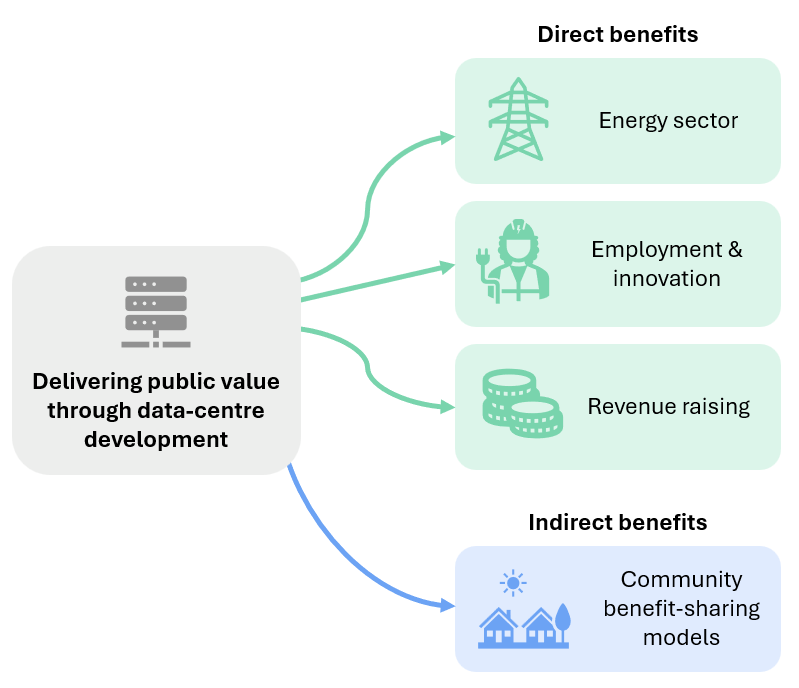
To do this means thinking carefully about where public benefits can come from. There are four main areas to consider: the energy sector, employment and innovation, revenue raising, and community benefit-sharing models.
The proposed investment in AI data centres in Australia is massive, potentially reaching
$150 billion between now and 2030, while
reports suggest Firmus’s proposed Launceston facility alone could generate annual revenue of around $1.4 billion before tax, interest and depreciation. The longer-term sustainability of Firmus’s business model will be clearer when more information is released on
8 October, but there’s little doubt that AI data centres have the potential to generate significant value. The challenge is making sure Tasmania gets a meaningful return from hosting them.
Energy sector
One of the biggest and most complex issues surrounding data centres in Tasmania is their significant electricity consumption. The three facilities proposed by Firmus would require up to
450MW of electricity, equivalent to around 30% of Tasmania’s current electricity consumption. This would make Firmus the state’s largest single power user.
Given the numbers involved, Tasmanians are understandably asking where the power will come from, how much data-centre operators will pay for it, and whether their ability to pay top dollar could price existing industries out of the market.
Fortunately, most of Tasmania’s electricity system is state owned, which creates opportunities to capture some of the benefits of higher prices. But with supply constrained until the early 2030s, there are also difficult trade-offs to manage.
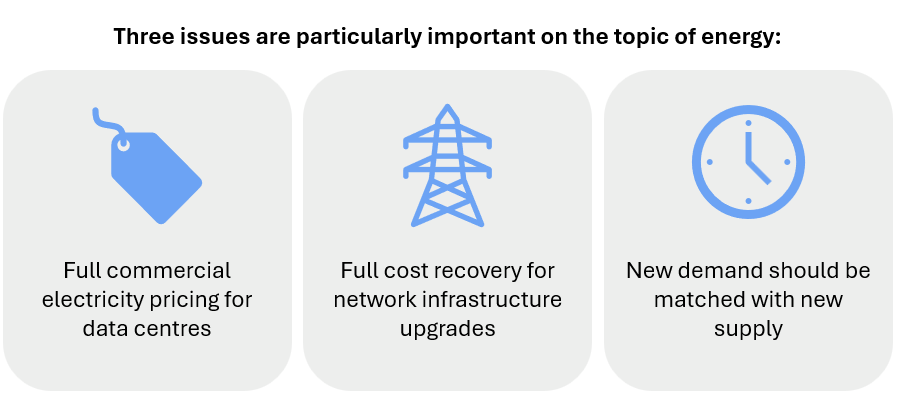
1. Full commercial electricity pricing for data centres.
The debate about the price Hydro Tasmania charges Major Industrial (MI) customers has intensified now that Hydro could potentially achieve greater returns supplying data centres or exporting to the
NEM during price peaks. On the other hand, the MIs argue that they were established on the expectation of affordable power and to employ thousands of Tasmanians, underpin local supply chains and regional communities, and support vital infrastructure and services.
Ideally, data centres wouldn’t compete with existing businesses for power. They should enter secure, long-term purchase agreements prices that reflect the current cost of new generation projects (approximately $150 MW firmed). But Tassie’s electricity system is finely balanced, and there’s unlikely to be enough power for AI data centres to operate at the proposed scale and full capacity until the early 2030s, when Marinus Link and new wind projects potentially come online.
2. Full cost recovery for network infrastructure upgrades.
Supplying data centres need will require significant upgrades Tasmania’s transmission network. As we noted in Part 1, upgrades in George Town and Bell Bay alone will cost an
estimated $370 million.
The Tasmanian Government’s
Draft Expectations rightly proposes that developers pay their fair share of network upgrades so existing customers are no worse off. The National Energy Market (NEM) rules for large energy users (including data centres) are also being reviewed.
There could also be a longer-term benefit from bringing new industrial consumers online. If any MIs cease operating in the coming years, additional large users could reduce the risk of Tasmania’s transmission costs being spread across a declining number of customers, pushing up prices.
3. New demand should be matched with new supply.
As agreed by the
Energy and Climate Change Ministerial Council in May, data centres must eventually match or better their electricity needs with new renewable generation. The challenge is timing. As the Tasmanian Government’s
Draft Guidelines notes, new generation “may not align with proposed data centre and AI infrastructure projects becoming operational.” Proponents should transparently demonstrate how they will manage operations until new generation comes online, without relying on high-impact, short-term measures such as diesel generation.
Together, these issues put Hydro Tasmania at the centre of both enabling AI data-centre development and in ensuring Tasmanian taxpayers and energy consumers benefit from it. The principles behind energy supply agreements (and as much of their details as possible) should therefore be transparent. As we have
argued elsewhere, Hydro Tasmania’s role in economic development should be clarified through a revised
Ministerial Charter.
Employment and innovation
Data centres employ relatively few people directly, but that doesn’t mean their wider employment and innovation benefits are insignificant. With the right policy settings, Tasmania could use data-centre investment to build its skilled workforce and support a broader innovation ecosystem.
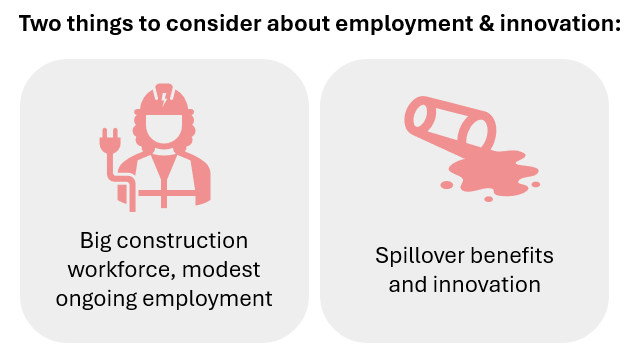
1. Big construction workforce, modest ongoing employment.
Despite generating significant revenue, data centres employ very few people directly once operational.
Firmus’s proposed Tasmanian facilities, for example, are expected to have a permanent workforce of around 175 people. These jobs are highly skilled and well paid, but data centres will never be a cornerstone of regional employment in the same way the MIs have historically been.
Direct employment is much greater during construction and fit-out,which require extensive electrical, HVAC, network, and engineering expertise. These specialised skills are already in high demand, but continued data-centre investment could also create an opportunity to expand Tasmania’s skilled workforce.
Tasmania could capitalise on this by partnering data-centre operators with education and training providers to create local training pathways. In 2025, for example,
Microsoft and TAFE NSW established a Datacentre Academy at Meadowbank, providing hands-on technical training, mentoring, and pathways into data-centre roles.
2. Spillover benefits and innovation
The wider economic benefits of data centres could extend well beyond their direct workforce. Investment could help enable new renewable-energy projects and infrastructure such as data cables, improving Tasmania’s digital connectivity with the rest of the world. Developers could also support local businesses and communities through contracting and procurement.
But there’s also an opportunity to use data-centre infrastructure more deliberately to strengthen Tasmania’s research and innovation ecosystem. Other governments have sought to do this by making computing capacity available to researchers, universities, start-ups, and businesses that might otherwise struggle to access or afford it.
Finland’s LUMI AI Factory is a good example. It provides eligible researchers, AI start-ups, and small and medium-sized businesses
free access to computing resources, alongside commercial access for larger companies. Other large tech companies like Amazon and Microsoft have also established STEM-in-Schools programs to show students to infrastructure, technology, and industry careers. A carefully designed Tasmanian program could help the address the significant decline in Tasmanian students studying STEM subjects.
These measures could help Tassie build its research, innovation, and digital capability, rather than simply hosting AI infrastructure that primarily serves users elsewhere.
Revenue raising options
Governments have long taxed profitable businesses to ensure communities receive a share of the value they generate. The art, of course, is doing this fairly and efficiently without deterring investment.
As we outlined in Part 1, the distinctive business model of AI data centres makes many traditional tax instruments ineffective. Governments elsewhere have responded through targeted taxes and charges on things like land and property, data-centre equipment, and electricity consumption.
Tasmania, however, has fewer options at the state level. Data centres are likely to pay very little payroll tax because they employ few permanent staff. They will pay land tax, but because land tax is levied on unimproved land value, the enormous value of the data centre itself is not taxable. And
since 2023, introducing a new state tax on data-centre equipment, or a consumption tax on data-centre electricity or water use, would almost certainly be unconstitutional.
But this doesn’t mean we’re out of options. Tasmania’s councils could raise considerable revenue from data centres through council rates. The
Local Government Act 1993 (Tas) gives councils broad latitude to vary general rates or service charges according to the use, location, or planning zone of land. Several councils already use these powers to raise additional revenue from
wind farms,
mines and quarries,
short-stay accommodation, and other uses.
Any revenue mechanism would need to balance capturing public value with maintaining Tasmania’s attractiveness as an investment destination. Ideally, there would be a consistent state-wide approach to taxing data centres rather than different arrangements across councils. Importantly, a proportionof any additional revenue from taxation or energy would be reinvested in communities and help regional economies manage future transitions.
Broader community benefit-sharing models
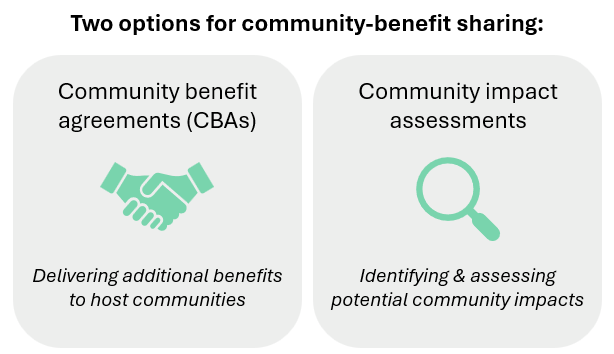
Beyond the economic benefits, there are a number of indirect mechanisms to increase the community benefits from hosting AI date centres and other major projects. Two options are particularly relevant for Tassie:
The first is
community benefit agreements. Data-centre developers could be required to negotiate
community benefit agreements (CBAs)
that deliver local infrastructure, community facilities, and other benefits to regions impacted by development. This could be required as part of the planning approval process. Byron, New York (a town of fewer than 3,000 people) secured almost
US$25 million for the community over 20 years as part of a CBA.
The second is
community impact assessments. Developers could also be required to assess and disclose potential community impacts as part of the planning process, including things like visual amenity, noise, water use, and electricity infrastructure. This approach is normal practice inthe UK and Nordic countries and helps communities and decision-makers better understand what the potential benefits and impacts are before projects are approved. Currently this is only required under particular
planning approval pathways where social, environmental, economic, and community issues must be considered within a project.
In Tasmania, responsibility for assessing data-centre proposals primarily sit within the State's
Resource Management and Planning System (RMPS), with development applications generally assessed by the
relevant local council. Although the RMPS provides opportunities for
community participation, it’s primarily focused on planning and environmental matters rather than broader questions of energy-system and economic impacts or long-term community benefits.
For these reasons, there is a strong case for future data centre proposals to be assessed by the Tasmanian Planning Commission under the Major Projects process. Another option would be a new statutory approach similar to
Queensland’s 2025 Amendment to their planning framework, which requires proponents to engage directly with communities and specify community benefits.
Conclusion
Despite the controversies, the reality is that Tasmania has an opportunity to benefit from significant investment in AI data centres. But those benefits aren’t guaranteed and won’t happen automatically. This PIMBY has outlined a range of policy options that could help. Getting the policy settings right means managing the pressure on our energy system while finding ways to build local skills and innovation, capture a fair return, and deliver benefits for our host communities.
The Draft Statement of Expectations is a good starting point, but high-level expectations should also be turned into a binding policy framework as soon as possible. Until then, proponents should explain how they intend to meet the community expectations currently being developed. Energy-supply agreements offer another important opportunity to establish the terms on which AI data centres are hosted in the State.
Ultimately, the question isn’t merely whether Tasmania hosts data centres, but what types of data centres we want and what benefits we get from hosting them. Getting that balance right will determine whether data centres contribute to our long-term prosperity, or simply creates infrastructure that mainly serves users and businesses elsewhere.
This PIMBY is part of two-part series, you can read the first PIMBY
here.
Thanks to UTAS colleagues and TPE partners who provided input for this PIMBY.
.png)





.png)