PIMBY – the first in a two-part series – we dive into the challenges and
opportunities associated with building AI data centres in Tasmania. In Part 2, we’ll put forward some policy ideas for minimising the risks and maximising the benefits of hosting AI data centres in our state.
Our aim isn’t to argue that Tasmania should go all in on AI data centres, or ban them – it’s to make sure that if we build them here, we do it on our terms and in a way that benefits our state.
Information source:
Congress and
EPRI.
The AI data centre boom
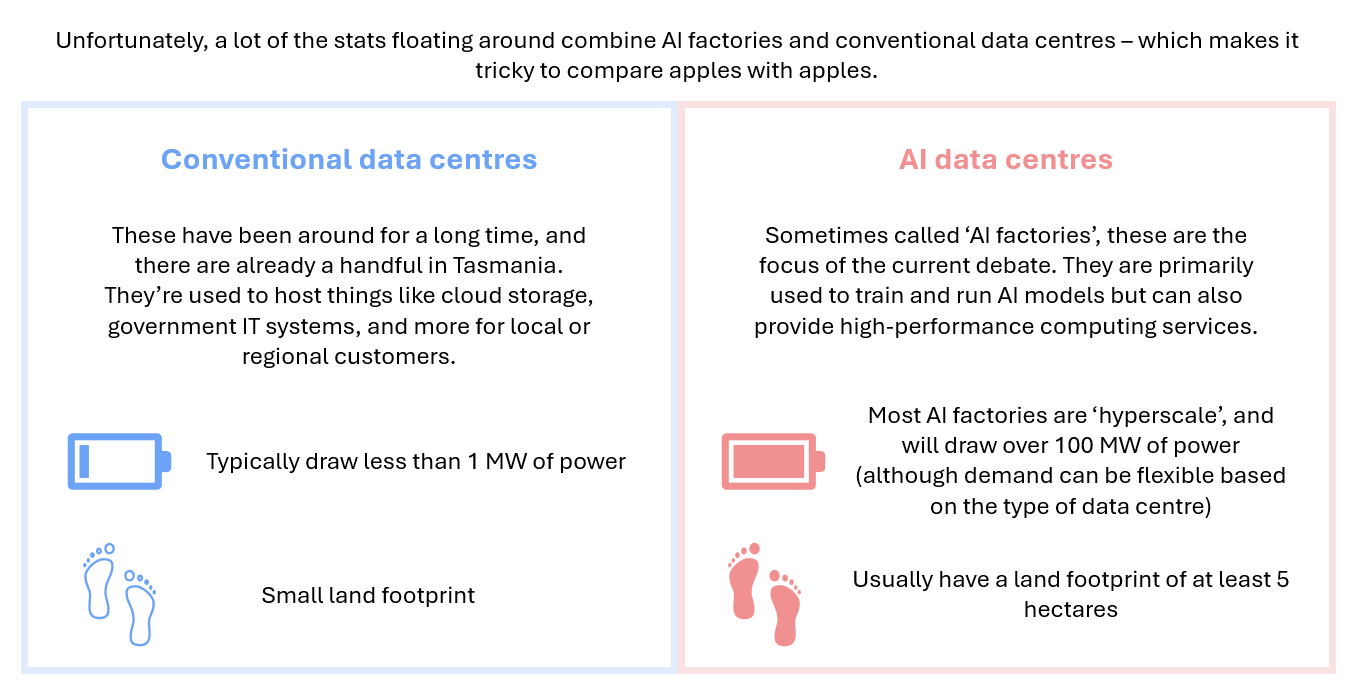
AI data centre construction is accelerating across the globe, and Australia is no exception. There are 90 data centres currently in the planning pipeline nationally – and most are over the 100 MW hyperscale threshold. The Federal Government aims to position Australia “
as a leading destination for data centre investment” and is keen to
emphasise the potential benefits, from job creation to enabling cutting-edge research.
Tasmania is also caught up in the boom, with developers attracted by our cool climate, water availability,
improving digital connectivity, and
renewable energy. The most advanced projects come from Firmus, which has requested
450 MW of power from Hydro Tasmania to run three ‘AI factories’ in Northern Tasmania. This would make Firmus by far the state’s biggest single electricity user.
Six other potential data centre projects totalling 500 MW – enough to power all the homes in Tassie with a bit to spare – are being facilitated by the Office of the Coordinator General, although detail is limited.
The boom has governments across Australia scrambling to get to grips with the question of AI data centres. Several jurisdictions, including
Tasmania and the
Commonwealth, have sketched outlines of their policy approaches. But there’s still
fierce national cabinet debate, regular calls for stricter regulation, and various ongoing inquiries – it feels like everyone is on the back foot when it comes to developing an effective policy response. That’s why in Part 2, we’ll look at the policies and regulations that could help ensure that building AI data centres contributes to Tasmania's long-term prosperity and resilience.
How could building AI data centres affect Tasmania?
In this PIMBY though, we wanted to lay out the scope of the policy challenge facing Tasmania. So, let’s take a look at six key domains where AI data centres are likely to have significant impacts:
Energy
The distinctive characteristics of Tasmania’s energy system create opportunities and challenges for AI data centre development.
The first issue is energy generation. We currently have very little surplus energy to export or power new industry on-island. Several new renewable energy projects have been proposed and some have been approved, but we haven’t had a major facility come online since
Cattle Hill in 2020 – although the 288 MW
Northern Midlands Solar Farm may not be far away. However, the prospect of
Marinus coming online in the next five years may spark new generation projects, and when the interconnector is operating, it will increase our capacity to import electricity from the mainland.
The energy demand landscape is changing though. The
future of some of our biggest electricity users is uncertain, and each one that shuts down will suddenly mean a lot more electricity to go around. If this happens, having AI data centres to soak up the load, underwrite grid costs, and pay a full commercial price for power could be very handy – although this could introduce a form of ‘
concentration risk’ by making the grid heavily reliant on a small number of customers from a single industry.
The second challenge is the capacity of Tasmania’s existing transmission infrastructure. Parts of our network
currently wouldn’t cope with AI factory loads: infrastructure around George Town and Bell Bay will probably need to be upgraded at an estimated cost of
$370 million once committed load reaches about 210 MW. Additionally, because Basslink is already constrained, extra demand would compete directly with the interconnector for network capacity. It is therefore essential that data centre proponents meet the full cost of network upgrades so that other consumers don’t have to pick up some of the tab.
Linked to this, the prospect of large new AI data centre loads could drive investment in electricity infrastructure that is later underused if the
AI bubble bursts (a form of ‘stranded asset risk’). While demand for AI is currently strong, the
long-term outlook is less certain. And, at the local level, operators’ commercial arrangements are often secretive, making it
hard to assess their resilience [paywalled] to changes in the sector. If major network upgrades and new generation capacity occur for projects that are then delayed, scaled back, or cancelled, Tasmania could be left paying for
underutilised infrastructure.
There are also opportunities here. Growing demand from AI data centres could support
generation and network investment that would not otherwise proceed. And, if data centre operators are willing to pay more for electricity than existing industrial users, Hydro Tasmania and the Government could receive a big revenue boost.
But there’s a trade-off here. Some established industries rely on low-cost power to remain competitive, and higher prices could make it harder for them to survive. If they exit the state, we’d lose the benefits they provide including regional employment, industrial capability, and supply-chain resilience. We need to assess not only which user can pay the most, but which use of Tasmania’s electricity delivers the greatest public value.
Community
Part of the challenge here is that the costs and benefits of AI data centres are often distributed unevenly. Most of their potential positive impacts (such as increased investment, innovation spillovers, and electricity revenue) happen at the broader economy level. Yet many of the negative impacts, including disruptive construction, noise, visual amenity impacts, and pressure on local infrastructure, are concentrated in the host community.
On the positive side, AI data centres may create benefits for host communities. For example,
waste heat from Meta’s data centre in Odense, Denmark is used to heat water that is added to the city’s heating system. In Tasmania, uses for waste heat could include industrial processes or keeping greenhouses warm. Other community benefits might include job creation or support for shared infrastructure, such as fibre optic connections and water supply network upgrades.
For Tasmania, the challenge is to ensure that the process for planning and approving AI data centres is transparent, legitimate, and trusted by affected communities.
Public revenue

The figures for investment in AI data centres are staggering (one estimate puts Australia’s current pipeline at
$155 billion) as are the potential returns for operators. A
report commissioned by the sector found that between now and 2030, data centre construction is expected to generate $19.8 billion in economic activity, and that when these facilities come online they will create
$5.6 billion in economic activity every year. This investment could present a big opportunity to capture significant economic value for Tasmania – although
international research suggests that these predictions should be taken with a grain of salt.
This is partly because headline investment figures don’t necessarily translate into local economic benefits. The
Australian Financial Review [paywalled] has argued that much of Australia's projected data-centre investment boom is associated with imported technical equipment, which means the money goes overseas. AI data centres are also unlikely to add much to public coffers via state taxation: they don’t generate royalties like mining and, given their low ongoing employment, they’re unlikely to be liable for payroll tax. This means the Tasmanian Government needs to think carefully about how to retain economic value in the state – we’ll share our research on how governments elsewhere are doing this in our next PIMBY.
Employment and workforce
The workforce benefits of AI data centres are often cited as one of their principal economic advantages. AI data centres could represent an important opportunity to strengthen Tasmania's skills base by
increasing demand for skilled workers across construction, electrical engineering, power systems, network administration, cybersecurity, and digital infrastructure management.
The potential issue here is whether workforce supply can keep up with demand. Nationally,
NECA warns that data centres are adding to existing competition for construction workers, electrical trades, and network engineers. Unfortunately, many of these skills are already in high demand here in Tassie due to the renewable energy transition and other large infrastructure projects such as the Stadium. There is a risk that AI data centre construction demand could
drive up costs across the construction sector.
It’s important to note that the employment impacts of data centres differ from many other industries. Data centres are capital-intensive, not labour-intensive: the construction phase creates employment, but their ongoing operations require relatively few workers.
Industry benchmarks suggest that highly automated data centre campuses require about 25 to 40 permanent staff per 100 MW. Firmus estimates its proposed 52 MW Wesley Vale facility will support
70 construction jobs but only 20 ongoing roles. However,
emerging research shows that hyperscale data centres can create additional jobs in related sectors through innovation spillovers (see below).
Innovation and sovereignty

A potential benefit of AI data centre investment is the possibility of improved on-island access to
high-performance computing, an increasingly important input to research and innovation. Access to this in Tasmania could improve our R&D capability in key sectors of our increasingly data-dependent economy. It may also generate wider ‘innovation spillovers’ by supporting the development of Tasmania’s tech sector – which, as noted above, could create additional jobs in the state.
However, these benefits will only materialise if local customers are granted access on favourable terms. The hyperscale facilities currently proposed aren’t being developed as shared research infrastructure or to support the Tasmanian tech sector – they’re commercial assets intended to generate income for their operators. We don’t automatically get R&D benefits just by hosting AI infrastructure here – as
Ireland has found out.
More broadly, AI data centre investment in Tasmania could incentivise improvements in our digital connectivity. While Tasmania is connected to the mainland by multiple Bass Strait fibre links, the state's digital economy has historically relied on a relatively limited amount of high-capacity
‘lit’ fibre and relies on mainland networks to reach Australia's international cable gateways. The risks of this were highlighted in 2022, when
damage to a Bass Strait cable caused widespread telecommunications disruptions. There is already an example of hyperscale investment supporting broader digital infrastructure: Firmus is
underwriting construction of the Bernacchi-1 subsea cable, which will connect to Melbourne and Sydney and add 60 terabits per second of capacity. Importantly, this general-purpose digital infrastructure will benefit businesses, researchers, and residents as well as data centre operators.
Water management
So, what do we do about all this?
As we’ve tried to show, building AI data centres in Tasmania comes with some big opportunities for the state – but there are also significant challenges and risks that need to be carefully managed. Experience globally has shown that the
impacts of AI data centres are not predetermined – they depend on the policies that governments at all levels put in place to allocate energy resources, manage infrastructure investment, capture social and economic benefits, and protect the environment. So, in Part 2 we’ll take a look at what the Tasmanian Government and others could do to make sure that if we forge ahead with data centres, Tasmania is better off.
.png)





.png)