The goal of budget repair
Our starting point is that the State Budget should be financially sustainable. We like
Saul Eslake’s definition: ‘financial sustainability’ is when the Government is able “to maintain spending, taxation and other policy settings indefinitely without the need for major remedial policy changes.”
There are several
technical measures for financial sustainability, but the two numbers to keep an eye on are the Net Operating Balance (NOB) and the Cash Balance (CB). The NOB is what's called an
'accrual' measure of the difference between a government's revenue and expenses that includes some 'non-cash' inputs and excludes payments for capital projects.
The CB, on the other hand, is a simpler 'money-in minus money-out' measure of the
difference between all cash receipts and all cash payments, including payments for capital spending (like roads and bridges). The NOB is perhaps a better indicator of a government's long-term fiscal sustainability whereas the CB is better for understanding whether governments can meet their day-to-day expenses without adding to net debt.
There's another important difference that's particularly relevant to Tasmania which is that the NOB treats grants from the Commonwealth as income but doesn't include grant-funded capital spending. As a snapshot of our fiscal health, this means that the NOB is probably more misleading in Tassie than elsewhere because of our heavy reliance on grants and out large net debt.
If the CB is in deficit, the Government is spending more than it earns, increasing debt over time. Rising debt means rising interest repayments, and less money for essential services.
Short-term deficits can be justified during economic downturns. For example, during the
COVID-19 crisis, huge public spending helped protect vulnerable households and support businesses. However, such a crisis response can’t go on forever because growing debt imposes a significant burden on future generations.
The big budget problem
The current situation is pretty dire. The most recent
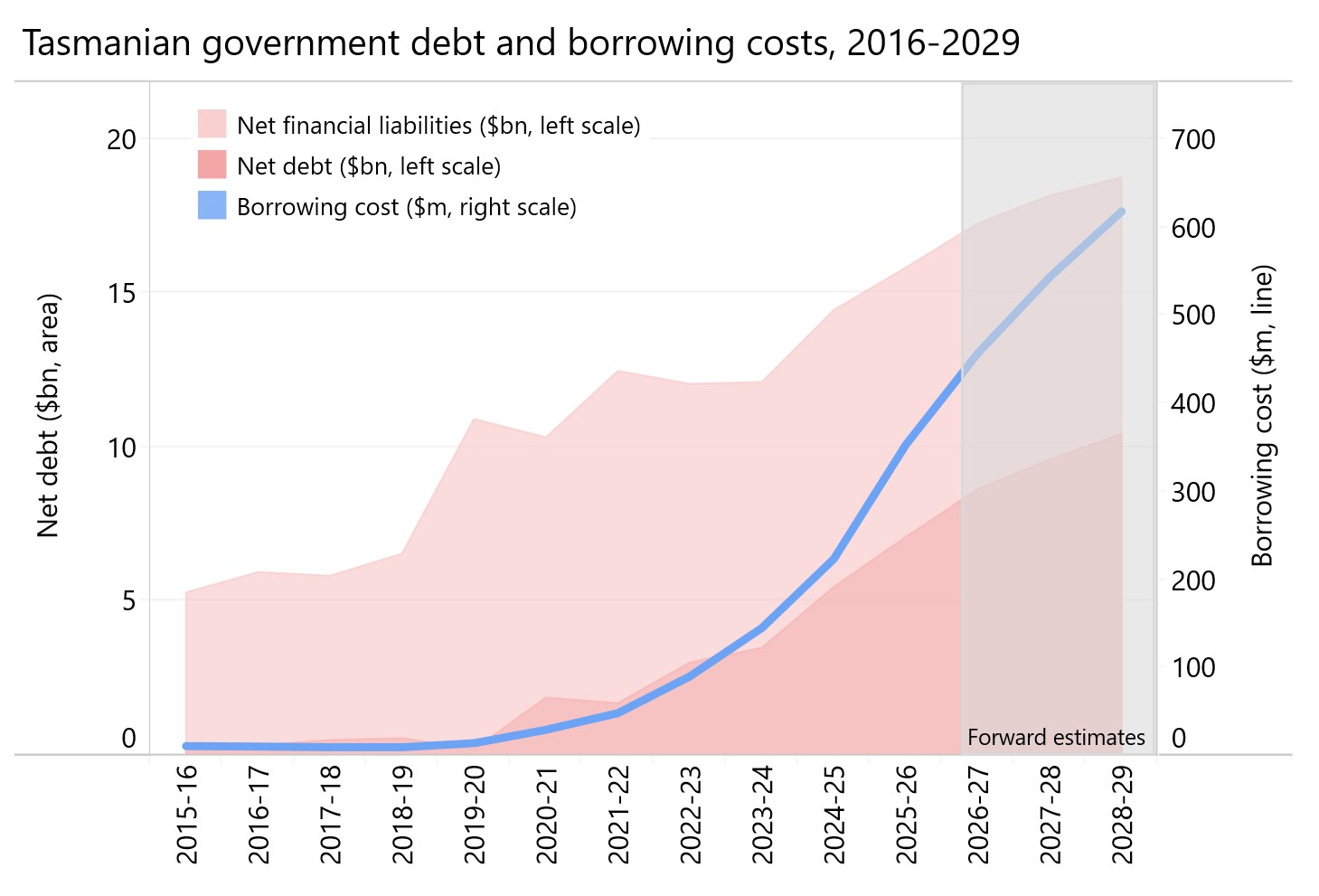
Revised Estimates Report put our cash deficit for 2025-26 at more than $1.2 billion, which means that we've needed to keep borrowing in order to fund the delivery of basic services. Growing cash deficits have seen Tassie’s net debt balloon from $1.7 billion to just over $7 billion in the past five years. When we add in unfunded superannuation liabilities and the debts of state-owned businesses, that figure swells to $15.8 billion.

In his 2024
Independent Review of Tasmania’s State Finances, Eslake concluded that the deterioration in the state’s finances was
“entirely attributable” to government policy decisions. Treasury has reached a similar conclusion. Its February 2026
Financial Sustainability Report (FSR) warned that Tassie’s finances have “worsened significantly” since 2021 and will continue to deteriorate without corrective action. Our analysis (chart below) of the State Government’s attempts to achieve budget savings targets over the past decade also shows that chronic overspending is the root cause of our budget challenge.

We need to act now
The Treasury Financial Sustainability Report notes that:
"Immediate action is required to stabilise debt. Doing nothing is not a responsible option."
As the saying goes, "the best time to plant a tree was 20 years ago, but the second-best time is now." With the state's finances
projected to rapidly deteriorate, the Government needs to act quickly or it will hurt more later. The longer debt builds, the
more difficult it becomes to restore sustainability – ultimately requiring harsher corrective measures.
The Government’s
February update forecasts that the NOB will improve from a $916 million deficit this year to a $95 million surplus in 2028-29. If achieved, this would put us back on a sustainable footing. However, given our recent failure to meet savings targets, the Government needs to clearly explain how it intends to achieve that outcome – and begin making meaningful progress before the next state election.
Cash from Canberra
Around 67% of Tasmania’s revenue comes from the Federal Government, including both payments for specific purposes (~27%) and GST revenue and other untied grants (~40%). In the 2026-27 Federal Budget, we received a nice surprise: the amount of general revenue assistance we’re projected to receive over the next four years was $1.2 billion more than earlier forecasts. This is because
a mix of inflation and higher than expected consumption mean that the Federal Government is set to take in more GST than expected.
However, a significant chunk of this additional funding is likely to be eaten up by the higher cost of providing services. What inflation gives with one hand, it takes away with the other.
Reforming pathways: choosing your trade-offs
Treasury's
modelling outlines two 'credible pathways' to sustainability:
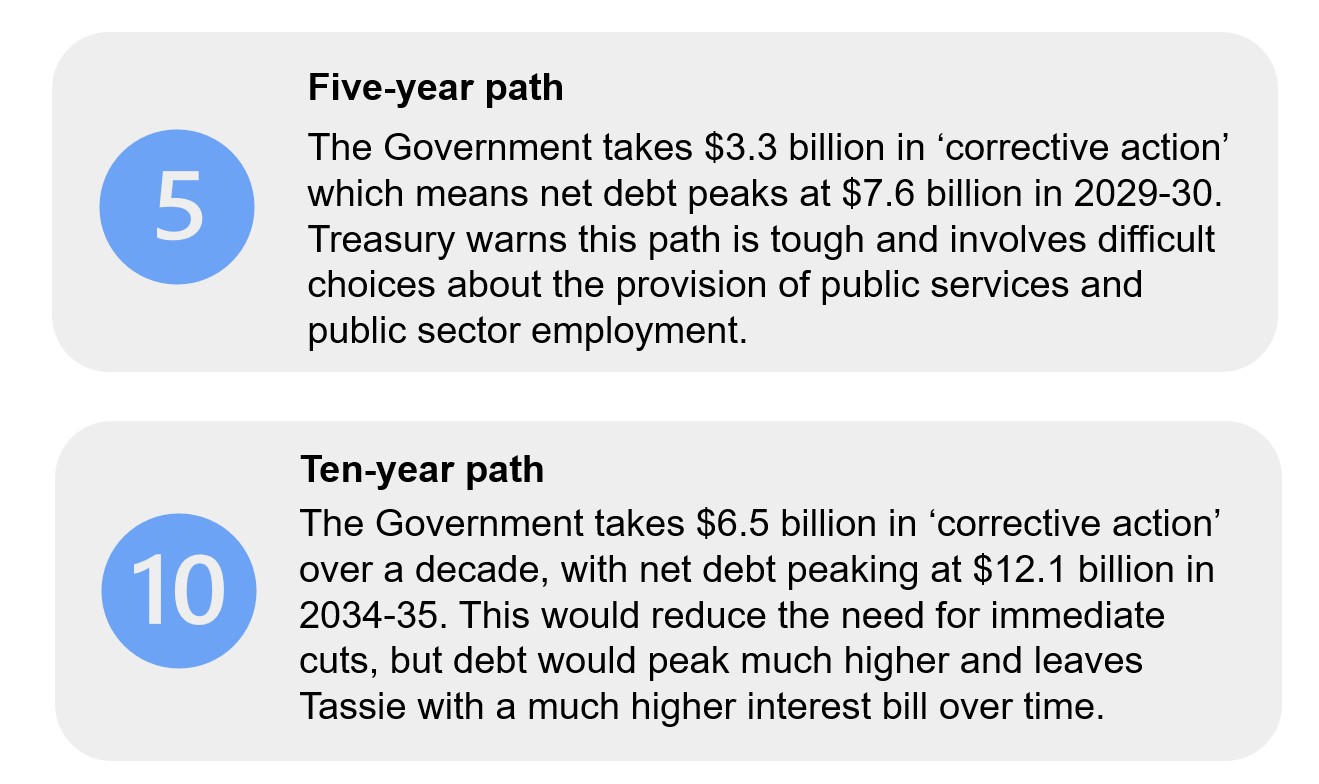
For each pathway, Treasury found that the economic impacts of budget repair will be smallest if the Government uses a range of policy levers rather than relying too heavily on one or two approaches. This suggests that sustainable budget repair will require a combination of spending restraint, productivity improvements, and improved revenue gathering measures.
So, the Government needs to use a combination of ‘levers’ rather than a single option. In this section, we give you a high-level overview of what those levers are, their inevitable costs and trade-offs, and some suggestions for how they could be used.

1. Reduce operational spending
Operational spending is the largest controllable element of the State Budget. It covers salaries and other costs for Government employees (e.g., nurses, teachers, police); consumables (e.g., hospital supplies, IT systems), as well as the day-to-day costs of delivering services such as health, education, and justice. Salaries and superannuation alone accounted for an estimated 47% of expenditure in 2024-25.
Put simply, the Government has two main options here: limiting salary increases; or reducing the size of the public service. Restraining pay rises would reduce budget pressures but is unrealistic given rising inflation and cost-of-living pressures. We’ve already seen
rolling strikes from teachers, doctors, and more as they protest that their wages are the lowest in the country and haven’t kept pace with inflation.
The second option has proved to be very difficult. Since
2023, the Government has had a target of 5,315 full-time equivalent (FTE) ‘
general government sector’ employees per 100,000 Tasmanians – but as of 2024-25, the figure was 5,814. Even though the size of the public service has been increasing, many Tasmanians feel that essential services are letting them down. This makes cutting ‘frontline jobs’ politically challenging, leaving the broader public service to bear the brunt of any cuts. Yet this also becomes problematic. So‑called ‘back‑office’ staff are the ones who make sure frontline staff get recruited, paid and rostered, keep IT systems running, coordinate programs, and ensure services are delivered safely and effectively. On top of this, the Government is the biggest employer in Tasmania, so cutting public sector jobs could also have a negative impact on the economy.

As we argued in
PIMBY #8, blunt instruments rarely achieve sustainable budget repair. A more credible approach would focus on improving how services are delivered while gradually bringing the size of the public service back into line with our population over time.
2. Prioritisation and productivity
Productivity reforms are one way to reduce operational spending – but they’re a fundamentally different and longer-term approach compared to cutting spending. The
crucial question is whether scarce public resources are being directed towards their highest-value uses – it comes down to doing the best we can with what we have. Tasmania’s fiscal problem isn’t just about how much is spent, but also whether spending is delivering the intended outcomes.
This points to
a few potential reforms:

It’s important to note that improving public sector productivity isn’t as simple as cutting costs. Public services are designed to provide things with ‘
non-price quality attributes’ because it’s usually the quality rather than the quantity of services that matters. For example, hospitals might avoid complex cases, or we might under-invest in early childhood services despite the long-term benefits. These trade-offs don’t always show up in the budget, but they come with real non-financial costs that are inevitably borne elsewhere in society. As we argued in
PIMBY #20, the challenge is to develop more sophisticated measures of
public sector productivity and assess the effectiveness of services against them.
The hard truth is that reforms designed to deliver more effective and sustainable services have to be carefully designed and implemented and rarely yield immediate savings. Consolidating programs, redesigning services and introducing new systems often require significant upfront investment before benefits are realised. Therefore, public sector productivity reform should be seen as an important medium‑term agenda to improve the quality and effectiveness of services and deliver savings.
AI and public sector reform
AI is a transformational technology which is already improving public sector productivity, particularly in high‑volume administrative tasks such as document processing, call centre support, and fraud detection. However, emerging evidence suggests AI should be treated as a long-term investment to deliver more responsive and effective services rather than a short-term budget repair tool. Real productivity gains require upfront investment in data systems, cyber security and governance and staff capability. The
real benefits of AI are likely to be realised once we reorganise systems and processes around the technology.
The 2026-2031
Digital Tasmania Strategy and the Tasmanian Government’s recently announced AI Accelerator both position AI as a tool for improving public service delivery and long-term productivity. Like other productivity reforms, the benefits are likely to emerge gradually over time.
3. Capital spending restraint
Another reform pathway is to defer or cancel spending on new or existing infrastructure. This can be a politically attractive option because cuts to infrastructure projects are less immediately visible than cuts to frontline services. It’s also a potentially big source of savings given the scale of Tassie’s infrastructure program: the Tasmanian Government’s capital spend this financial year will come in at
$871.3 million.
However, this approach comes with important trade-offs. A lot of state-level capital spending is for projects that receive ‘matched funding’ from the Federal Government, meaning it can’t be cut without losing that support. Also, over time, failing to build new infrastructure or repair existing roads, bridges, ports, and so on can reduce economic growth and ultimately lead to higher maintenance and replacement costs.
4. Grant rationalisation
Since the 1980s, governments around the world have funded a wide range of organisations to provide services and infrastructure, and the Tasmanian Government is no exception. In the 2025-26 Budget, ‘grant and subsidy expenses’ were forecast to total $2.54 billion, although this figure includes a broad mix of activities and varies from year-to-year. And, as with capital spending, the state often distributes grants on behalf of the Commonwealth.
At first glance, reducing grants may seem to be a straightforward path to budget savings, but poorly targeted cuts mean there is real risk of false economy. Most notably, community organisations rely on Government grants to provide vital services to vulnerable Tasmanians at relatively low cost, with deep specialist expertise gleaned over many years. The evidence suggests that
more secure and targeted funding is the best way to achieve social goals efficiently. Poorly targeted cuts would impact those in the
community in greatest need.
5. Tax reform and other measures
About 20% of Tasmanian Government revenue comes from state taxes. So, while there are options for increasing revenue as part of broader tax reform, they are insufficient on their own to get us out of our fiscal hole.

There are several revenue reforms worth considering as part of the budget repair discussion. Key options include:
- Introduce a broad-based property tax: There have been calls to introduce a broad-based property tax since the GST was introduced in 2000. It could replace stamp duty or, given the budget challenges we’re facing, be introduced separately. One option is a modest annual levy on high-value properties. For example, a 0.4% tax on the value of all homes above $1 million (only 15% of homes in Tasmania) could raise about $60 million per year.
- Lower the threshold for payroll tax: Payroll tax is Tassie’s largest state-level tax, raising over $600 million per year. Eslake has suggested we lower the payroll tax threshold and reduce the rate to support economic and employment growth. Payroll tax reforms could be either revenue neutral or positive depending on the model adopted.
- Increase mineral royalties: Tasmania charges some of the lowest mineral royalties in the country. Eslake’s Independent Review found that if we increased our royalty rates to something similar to the national average, they would likely raise around 40% more revenue per year.
- Reform poker machine taxation: Tasmania taxes poker machines in casinos at a far lower rate than in pubs and clubs – casino machines are taxed at just under 11%, compared to more than 30% everywhere else. A fairer system would tax all pokies on a revenue-per-machine basis, with higher rates for higher-loss machines. For example, Victorian hotel machines that bring in more than $12,500 a month are taxed at 65%.
- Re-introduce estate or inheritance taxes: Tasmania abolished estate duties in the late 1970s as part of a ‘race to the bottom’ with other states and territories. Re-introducing a duty on the top 10% most valuable estates could provide much-needed revenue for the Government without ever affecting the vast majority of Tasmanians.
None of these tax reforms would solve Tassie’s budget problems on their own because our budget challenges are largely driven by spending. But a fairer and more efficient tax system would still strengthen the budget and leave our state better equipped to fund essential services in the years to come.
What would you do?
With these options in mind, what would you do if you were Treasurer? Using our proprietary tool, you can choose which combination of reforms you would use to eliminate Tasmania’s deficit in 2026-27. In practice, the path to balance would likely be implemented over a few years.
Each reform area is linked to a different part of the budget (some of which are more important than others) so the same percentage change won’t have equal dollar impact on the deficit. For example, efficiency gains are hard to realise and only partially translate into budget improvements, while cuts to operational spending have a big impact. The tool isn’t meant to be precise – the goal is to give you a sense of the choices facing the Government.
Once you have decided on your approach, you can submit it anonymously. But think carefully: you only get one attempt! We might even do a follow-up PIMBY Bite on the most popular reform pathways.
It's all in the mix
By this point in the PIMBY, it should be clear that Tasmania needs budget repair – and soon. Our current trajectory is unsustainable. But that doesn’t mean the answer is just to slash and burn. As the
UK’s era of austerity showed, this can have devastating social and economic consequences.
Sustainable and effective budget repair requires a mix of all the reforms we’ve covered. We’ll need a carefully considered blend of spending restraint, efforts to raise additional revenue, and some serious work to improve the public service productivity. As we’ve acknowledged, state budgets are hard to understand and write about, but there’s a lot at stake here. The longer deficits persist, the more our debt accumulates and the greater the burden imposed on our future generations.
.png)






.png)