The current fuel crisis requires a coordinated response from government, industry, and the community. While households and businesses can make changes to reduce their fuel use, many of the most important policy levers are at the national level.
Working with the states and territories, the Federal Government has developed a
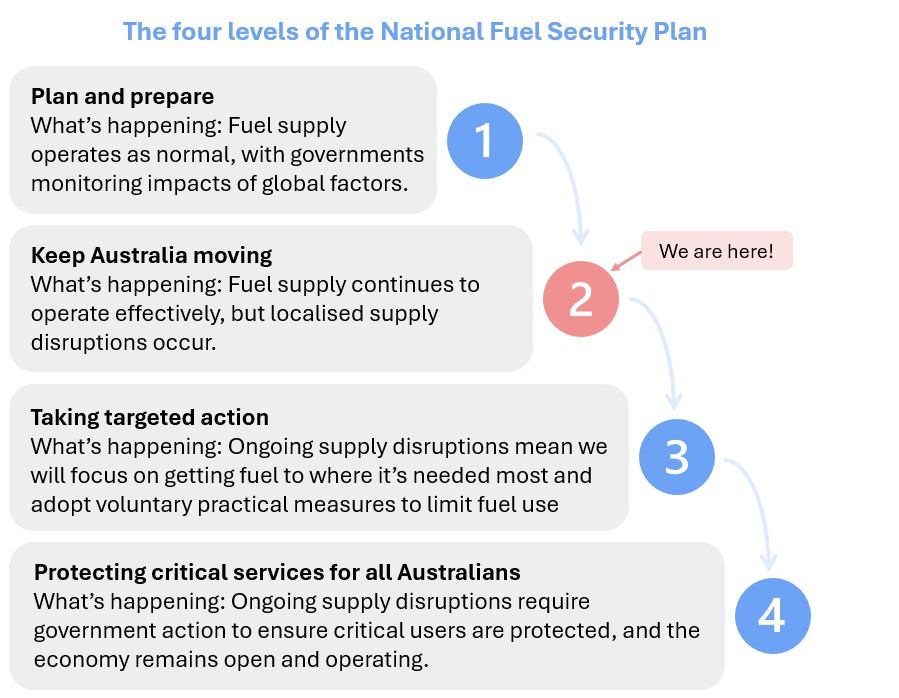
four-level framework to guide Australia’s response to the fuel crisis. Each level sets out a different mix of state and federal actions depending on the severity of the situation. The framework is mostly focused on fuel security and making sure fuel continues to flow where it’s needed most. This is important, but says little about how we should respond to the broader and longer-term impacts of higher fuel prices across the economy.
So, what have governments been doing so far? At the Federal level, the focus has been on securing fuel supply and easing immediate cost pressures. The Tasmanian Government has been trying to maintain confidence in supply and provide targeted short-term relief. Here’s a quick snapshot:
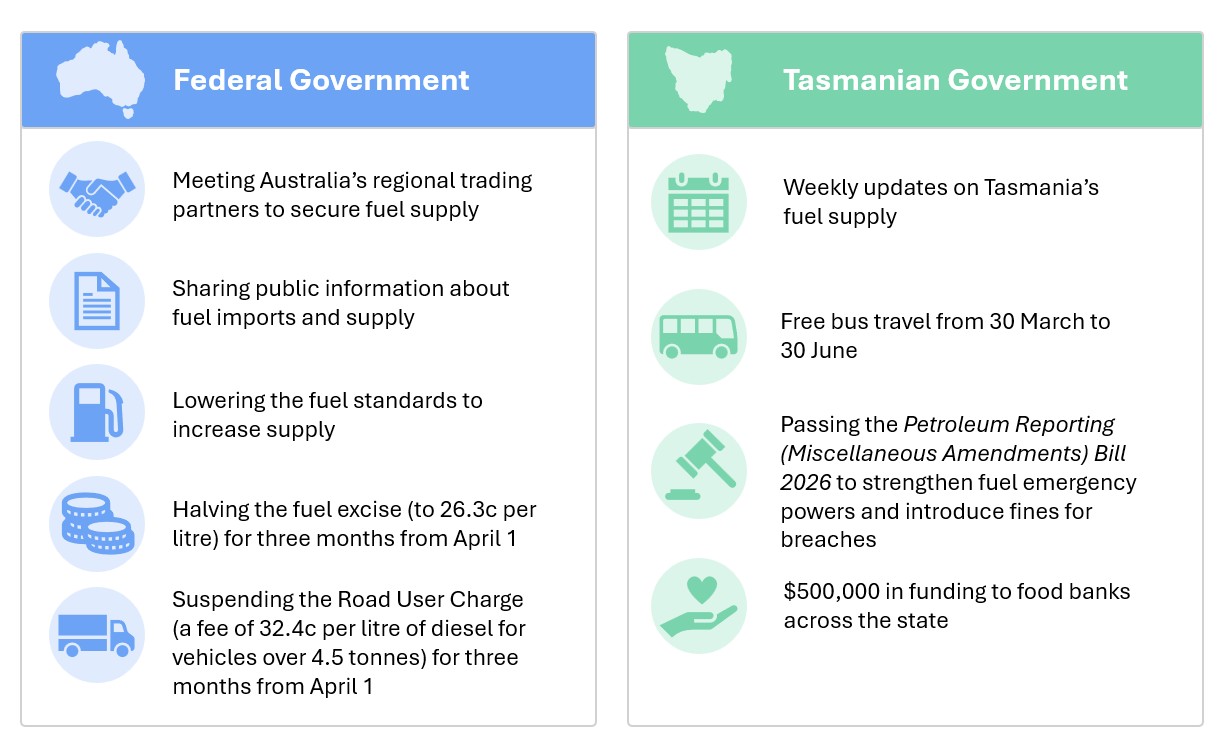
Alongside these measures, the Tasmanian Parliament’s Standing Committee of Public Accounts is conducting
an inquiry into the Government’s response to the fuel crisis and impacts on the Tasmanian economy.
Australia is not alone in grappling with the fuel crisis. Around the world, different countries are responding to the fuel crisis in a variety of ways, with some already experiencing acute shortages.
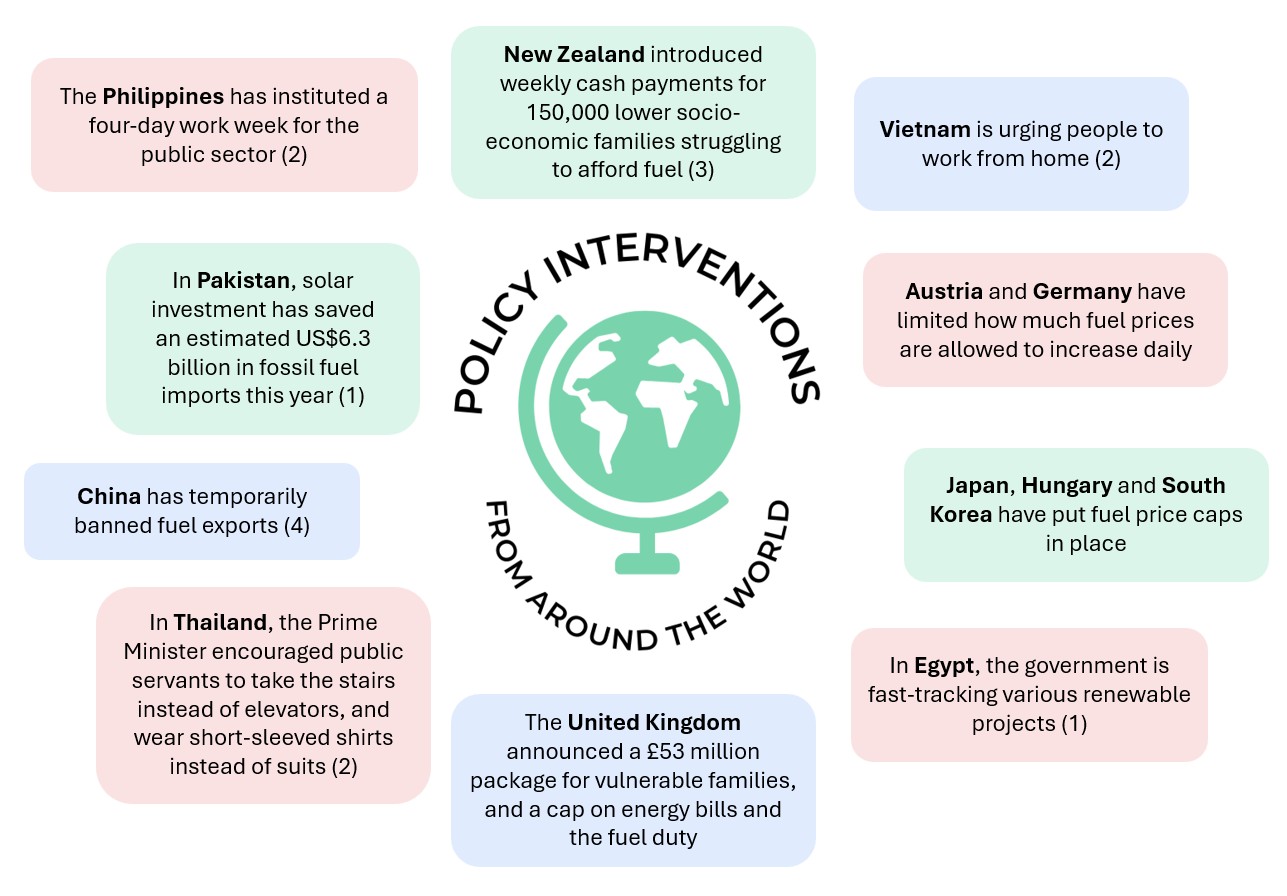
Information Source:
(1) (2) (3) (4) For more on international responses, you can check out the International Energy Agency’s
2026 Energy Crisis Policy Response Tracker.
You can't always get what you want
The fuel crisis is a complex problem with long-term implications, so responding to it involves some important trade-offs. Governments have had to act quickly to deal with the immediate shock of rising fuel prices, hence decisions like halving the fuel excise. But as the crisis continues, we need to make sure that policies are carefully designed to avoid inflation pressure and limit the cost to taxpayers.
At the same time, we have another challenge: how to address the short-term pain of higher fuel prices without undermining incentives to conserve fuel and invest in renewable alternatives. To balance these trade-offs, we propose three main principles that should guide policy design:
- Targeted and temporary
The cascading impact of high fuel costs is pushing up prices across the economy, resulting in inflation, higher interest rates, and potentially weaker economic growth. To ensure that government support makes a difference where it’s needed most, financial relief must target the most vulnerable households and businesses, and designed to be short-term. - Reduce fuel consumption
In the short term, this means encouraging households and businesses to change their behaviour so that our existing supply lasts as long as possible. Tassie’s fuel supply levels are looking pretty good at the moment, but if we only focus on making fuel cheaper, we risk being unprepared if the situation worsens and tougher measures (such as fuel rationing) become necessary. - Strengthen energy security
High fuel prices might be our current problem, but the deeper issue is our dependence on imported fossil fuels. Initiatives that simply make fuel more affordable risk increasing that dependence. Our policy response needs to boost Tasmania’s energy security by encouraging efficient fuel use and supporting the shift to renewable energy.
Taken together, these principles point to a policy response that does two things at once: helping households and industries get through the current difficult period, and reducing Tasmania’s vulnerability to future energy shocks. In the next section, we use the guiding principles and outline six policy ideas that could help achieve both.
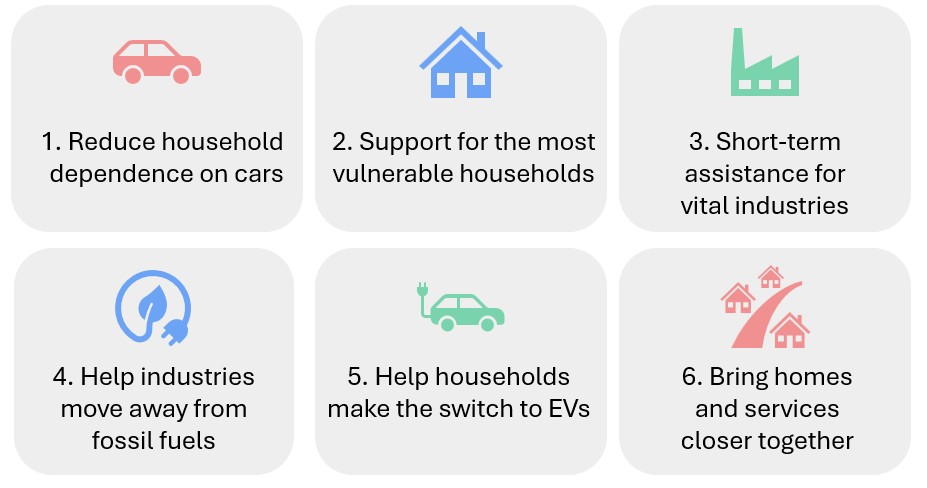
1. Reduce household dependence on cars
The fuel crisis presents a window for encouraging Tasmanians to shift their behaviour. This is important because once people begin using public or active transport, they are often less likely to go back to driving for every trip.
Free fares on Metro buses is a great start and has already led to a notable increase in ridership. However,
our research into Tasmanians’ attitudes to public and active transport shows that cost is only part of the story. Service quality (including wait times, travel times, and reliability) is by far the biggest barrier to greater public transport use. This means that increasing service frequency and addressing perceived reliability issues would likely make a much bigger difference to ridership than free fares alone. Better real-time tracking in the Metro app, for example, could help address some of the uncertainty that people have about using public transport.
The Tasmanian Government and Metro could build on this by using the wealth of data available on commuter behaviour and population shifts to improve trip frequency on key routes – particularly from regional areas to their nearest service hubs. The recent decision to
adjust Greater Hobart bus timetables to better reflect actual journey times is a positive step, but only one new route (Brighton-Hobart) being added suggests there’s still room for more improvement.
It’s important that strategies to reduce fuel use don’t neglect active transport – even though winter is just around the corner. Our survey found strong willingness among Tasmanians to cycle and walk more, but only if key barriers (notably safety and infrastructure quality) are addressed. Improving footpaths and bike lanes could make active travel a better option for more people.
2. Support for the most vulnerable households
Given the Tasmanian Government’s
dire financial position, the Federal Government would need to do most of the heavy lifting on this one. The Federal Budget on 12 May will likely include cost-of-living relief, such as the
reported tax offset of up to $300 per year. The Tasmanian Budget due later in May might also include some financial assistance, although by necessity this will be more limited.
Historically, Federal Government programs and support have been ‘means-tested’ to ensure assistance goes to households under the greatest pressure. This hasn’t been the case in recent years though, at significant cost to the budget. It’s crucial that financial assistance in response to the fuel crisis is timebound and targeted towards those who need it most – which will limit costs to the taxpayer. The simplest option would be direct payments to the lowest-income households delivered in the form of a supplement to existing welfare payments.
Something the Tasmanian Government could do is provide emergency funding for organisations that assist vulnerable households. The
additional $500,000 in one-off funding for food relief services is a good example that the Government could build on by also providing short-term funding for homelessness services and other frontline community organisations that are likely to experience increased demand as living costs rise further.
Given the uncertain outlook for fuel prices and the broader economic impacts still unfolding, the Tasmanian Government should work closely with local government and the community sector to identify where need is most acute and where additional support could make the biggest difference.
Car registration discountsNot all cost-of-living measures are equally effective. The
2026 Victorian budget introduced a 20% discount on vehicle registration (among other measures) at a cost of $756.5 million next financial year. While attractive up front, this policy response to the fuel crisis does not align with the three principles we outlined earlier: it isn’t means tested; doesn’t encourage reduced fuel use; and it doesn’t support the broader transition to renewables.
3. Short-term assistance for vital industries
As
PIMBY #21 highlighted, some businesses are being hit harder than others by rising fuel prices. Any government support should follow the same guidelines as household assistance: it should be targeted, temporary, and focused on the areas of greatest need.
The Tasmanian Government is already working with industry peak bodies to identify businesses with the greatest need. In line with our proposed principles, it will be vital for government initiatives to focus on:
- Supporting the industries that employ large numbers of Tasmanians and are crucial to supply chains. Road freight is a good example because it employs around 10,000 Tasmanians and is responsible for the movement of goods across the state, so it’s critical to both the economy and the community.
- Supporting businesses that were profitable prior to the fuel crisis and are likely to recover once fuel prices fall. This could include secured low- or zero-interest loans, proportionate to the additional fuel costs businesses are facing and repayable once the crisis eases. We should avoid broad subsidies or industry-level assistance grants.
Once the scale of the challenge has been mapped out, the Tasmanian Government should work with the Federal Government on options to co-fund concessional loans or other forms of assistance.
4. Help industries move away from fossil fuels
As we’ve said before, reducing industry dependence on fossil fuels is critical for the state’s longer-term economic resilience. To date, the State Government’s contribution has been through the sectoral
Emissions Reduction and Resilience Plans. We now need to focus on moving from planning to targeted action that encourages businesses to electrify or switch to biofuels. Let’s look at some options for two key industries.
The transport sector (particularly road freight) is heavily dependent on fossil fuels and is difficult to transition to lower emission options. But recent research from the TPE (coming soon!) found there are things the Tasmanian Government can do to help. One is making sure that the state’s roads are ready for high productivity vehicles (HPVs), which reduce fuel use by carrying more freight. While HPVs aren’t widely used in Australia yet, Federal Government is working to change this by removing regulatory barriers. The Tasmanian Government should also ramp up its support for clean fuels, as we argued in
PIMBY #14 – we’re still waiting to see the final version of the
Clean Fuels Strategy.
For agriculture, some of the strongest opportunities lie in ‘behind-the-meter’ solar generation and battery storage. Models like the
Weasel Solar Farm Station – which combines 4,000 solar panels with sheep farming – show how land can be used for both agriculture and renewable energy. The Government can support this shift by
removing regulatory barriers, such as restrictions on sharing electricity across property titles owned by the same farm. It can also provide low- or zero-interest loans for on-farm generation and storage projects, and upgrade infrastructure in rural areas so that farmers can export energy back to the grid.
5. Help households make the switch to EVs
As noted earlier, the main way Tasmanian households use fossil fuels is by driving. So, the best thing the Tasmanian Government can do to improve household energy security is to help people switch to electric vehicles (EVs). There are many ways for government to do this, from building charging infrastructure to reducing the upfront cost of purchasing an EV through low-cost loans or stamp duty rebates. Each of these measures can help eliminate the barriers that prevent many people from making the change.
At the moment, the Tasmanian Government’s main EV initiative is a grant scheme to help
organisations install or upgrade public charging infrastructure around the state. This is a great start, but with generous federal incentives and EV sales booming (
one in six cars sold nationally in April 2026 were EVs) we need to keep up the pace. Additional government support to rapidly increase the number of fast chargers on key highways will make EV ownership more practical for long-distance travel and regional Tasmanians.
6. Bring homes and services closer together
We also need to rethink how we plan our communities so that people are less dependent on driving in the first place. There are two main elements here: limiting urban sprawl, and bringing essential services closer to where people live.
One way to do this is through greater housing density in urban centres. The Government could reverse the
2025 decision to expand Hobart’s urban growth boundaries and instead encourage more medium-density housing in existing suburbs. This would make it easier to deliver
efficient public and active transport, while offering broader productivity, health, and infrastructure benefits. The
Committee for Greater Hobart and
University colleagues are already doing great work in this space.
The second part of the equation is decentralising services. When key services are located closer to where regional populations live it means people don’t need to jump in their cars as often.
In Northern Italy, for example, bringing cancer treatment services into remote mountain villages where patients lived saved more than 218,000 kilometres of travel. Closer to home, we already have great initiatives such as
Regional University Study Hubs that we can expand.
These things take time, so we need to start planning them now. Planning decisions shape how communities function for decades. The sooner we start, the sooner Tassie can begin reducing our vulnerability to fuel price changes.
Turning crisis into opportunity
At this point, we all know that the fuel crisis is making life harder for many Tasmanian households and businesses. So far, the focus has rightly been on fuel security and affordability. However, this crisis gives us the opportunity to make some profound choices and changes. Our long history of renewable energy generation, combined with various existing
strategies and plans, puts us in a great position to act decisively.
Now is the time to mitigate the second-order economic impacts of the crisis and reduce our vulnerability to similar shocks in the future. It will require carefully designed and targeted policy responses – not broad cost-of-living measures that put strain on government budgets and undermine the incentive to switch to renewables.
The decisions we make now will shape Tasmania’s long-term energy security and economic resilience. They will help determine whether future global disruptions leave us vulnerable to volatile fuel markets, or better protected by cleaner, more reliable, locally produced energy.
.png)






.png)